Product Lead & AI-Assisted Application Builder
X-Vendor
From Street-Food Ledger to Multi-Tenant, Multi-Outlet SaaS
Functional product / evolving commercial platform
Turned a real operational problem in a Nigerian street-food business into a tablet-first POS and ledger product, then evolved it into a multi-tenant, multi-outlet SaaS platform after interest from other business owners.
Visit xvendor.com- Role
- Product Lead & AI-Assisted Builder
- Surface
- Tablet-first web app
- Model
- Multi-tenant SaaS, subscription tiers
- Status
- Live product, iterating
01
Context
The original problem came from a friend in Nigeria who runs Deo Super Food & Event Services, public-facing brand Chef Deo. Her street-food operation relied on local POS terminals, cash payments, handwritten or fragmented ledger tracking and manual reconciliation at the end of the day.
It also ran in an environment with unreliable electricity and no practical receipt printer — the two assumptions most commercial POS products quietly depend on.
02
Problem
The problem was not simply “build a POS”. The business needed a reliable way to run the day and then understand it afterwards.
- Capture orders quickly at the point of sale.
- Reconcile sales and ledger records.
- Work around inconsistent electricity and printer availability.
- Give the owner visibility into business performance.
- Support discounts and repeat-customer loyalty.
- Give customers a receipt without introducing printer dependency.
- Eventually support multiple staff and multiple outlets.
03
Users
Primary users are the business owner and the sales staff working the terminal. Secondary users arrived as the product grew.
- Primary — business owner / founder: reconciles the day, needs to trust the numbers off site.
- Primary — street-food sales staff / terminal users: fast order entry while customers queue.
- Secondary — customers receiving digital receipts on their own phone.
- Secondary — future external business owners using X-Vendor for their own operation.
- Secondary — multi-outlet operators needing business-level oversight across locations.
04
Discovery
This was founder-led contextual discovery: I learned how the business actually operated before deciding what to build. I watched trading hours rather than interviewing after close, because the behaviour that matters — shortcuts, mis-keys, interruptions — only appears under pressure.
I mapped the end-to-end workflow from order taken to day reconciled, marking each point where information was lost. Most loss happened at two moments: when an item was sold without being written down, and when a discount was given verbally.
- Live observation of ordering, payment and end-of-day reconciliation.
- Workflow map of the manual ledger process with information-loss points marked.
- Review of existing POS tools against the vendor's real constraints (cost, hardware, connectivity).
- 01Observe existing operation
- 02Map order, payment and ledger flow
- 03Identify infrastructure constraints
- 04Define MVP
- 05Test in business context
- 06Iterate from feedback
- 07Expand platform scope
05
Constraints
The constraints defined the product more than the feature list did.
- Unreliable power — the app has to survive being closed mid-shift and resumed without data loss.
- No printer — receipts must be delivered without hardware.
- Tablet-first — one shared device, gloved or wet hands, glare, large tap targets.
- Low technical confidence — no training budget, no manual, no support desk.
- Cost sensitivity — the subscription has to be obviously cheaper than the problem.
Unreliable electricity
Power cuts are routine. The product cannot assume a session survives, so the sales flow has to be resumable and the record has to be safe the moment it is taken.
No receipt printer
There was no printer and no appetite to buy, power and maintain one. Proof of purchase had to be delivered without hardware in the loop.
Mixed cash and local POS payments
Payment happens across cash and local card terminals. The product records the sale and the tender type rather than trying to own the payment rail.
Very fast staff interaction
Orders are taken while customers queue. If digital entry is slower than writing it down, staff will write it down.
Owner-level visibility
The founder is frequently off site and needs to trust the day's numbers without reading someone else's handwriting.
Multi-business and multi-outlet separation
Once other owners showed interest, each business — and each outlet within it — needed clean separation of data, staff and reporting.
06
Product decisions
Each decision traces back to a constraint rather than to a feature request.
- QR receipts instead of printed slips — removes hardware cost entirely and gives the customer a durable record.
- Sales and ledger as one model, not two — the ledger is a view over transactions, so it cannot drift from reality.
- Discounts as a first-class, logged action rather than an untracked price override, closing the biggest information-loss point.
- Loyalty tied to the customer's receipt rather than a physical card, reusing a mechanism the customer already has.
- Staff workflows with per-user attribution so the owner can reconcile a shift, not just a day.
- AI insights framed as plain-language observations on the vendor's own data — never predictions presented as fact.
- Multi-tenant from the schema up, so a second outlet is configuration rather than a rebuild.
Decision 1
Tablet-first interface
Rationale — Staff needed a fast, simple order-entry experience suited to the operating environment: one shared device, large tap targets, minimal training.
Decision 2
QR-code digital receipts
Rationale — Avoids printer hardware, paper, maintenance and electricity requirements. Customers scan and keep the receipt on their own device.
Decision 3
Separate operational terminal from owner insight
Rationale — Staff need speed and simplicity; the founder needs deeper sales, ledger and performance information. Serving both on one screen would have degraded both.
Decision 4
Discounts and loyalty as product features
Rationale — Supports repeat-customer behaviour and gives the business practical retention tools, rather than leaving the product purely transactional.
Decision 5
AI-assisted business insights
Rationale — Lets the owner ask questions about business performance and receive practical, plain-language analytical suggestions instead of reading raw tables.
Decision 6
Evolve from single-business to multi-tenant
Rationale — Interest from other business owners indicated the original pain point was not unique to Chef Deo — so tenancy became part of the data model rather than a later bolt-on.
Decision 7
Multi-outlet architecture
Rationale — Discovery showed some target businesses run several locations and need business-level oversight without mixing outlet-level operations.
07
MVP & prioritisation
The first release did one job: replace the paper ledger without making the seller slower. Anything that did not serve that was deferred, even where it was commercially attractive.
- Must — sales entry, item catalogue, daily ledger view, QR receipt.
- Should — dashboard, discounts, staff accounts and attribution.
- Could — loyalty, AI insights, multi-outlet comparison.
- Won't (first release) — inventory forecasting, integrated payments, accounting export.
V0
Problem discovery and operational mapping
Observed the business, mapped order, payment and ledger flow, and named the real constraints.
V1
Orders, checkout and ledger tracking
Replaced the fragmented handwritten record with a single, fast transaction flow.
V2
QR digital receipts and owner dashboard
Removed printer dependency and gave the founder her own view of performance.
V3
Discounts, loyalty and AI insights
Made informal pricing behaviour visible and turned the data into plain-language answers.
V4
Multi-tenant architecture
Reworked the model so other businesses could run on the platform with separated data.
V5
Multi-outlet support and free/subscription model
Added an outlet hierarchy beneath each business and a tiered commercial model.
08
How I built it
I used an AI-assisted product development workflow: I defined the problem, users, workflows, requirements and feature priorities, then used Lovable to accelerate implementation. I reviewed the generated product, tested critical workflows, directed changes and iterated based on real operating needs.
My contribution is product judgement and technical direction, not line-by-line authorship. Where the generated implementation was wrong — data model shortcuts, unhandled offline states, unclear error paths — I caught it in review and testing and specified the fix.
- Write the requirement and acceptance criteria before any generation.
- Direct the AI tool to implement one scoped slice at a time.
- Review the result against the acceptance criteria and the data model.
- Test on the actual device class the product runs on.
- Iterate with vendor feedback and re-specify rather than patching blindly.
09
How it works
A single web application, installable on a tablet, talks to a shared backend where every record carries a tenant identifier. Outlets sit beneath a tenant, so an owner with two locations sees both without any duplication of accounts or catalogue.
Receipts are generated as a link encoded into a QR code — the customer scans and reads it on their own phone, so no printing hardware exists in the loop. Subscription tier is a property of the tenant and gates which features render.
Tablet-first progressive web application
Installable, touch-first surface designed for a shared counter device.
Business and outlet-aware data model
Every record is scoped to a business, and to an outlet beneath it.
Staff-facing transaction workflow
Order entry, tender type, discount and completion in the fewest possible steps.
Owner-facing analytics layer
Sales, ledger and performance views separated from the operational terminal.
Digital receipt generation with QR access
Receipts are generated as a scannable link, read on the customer's own phone.
Multi-tenant separation
Tenancy is part of the schema so businesses cannot see each other's data.
Multi-outlet hierarchy
Business-level oversight without mixing outlet-level operations.
AI insight layer
Natural-language questions answered against the business's own transaction data.
Backend, hosting and sync specifics
To verifyImplementation details to verify and document.
Offline queue and conflict handling
To verifyImplementation details to verify and document.
10
Validation & outcomes
Validation to date is qualitative. I am deliberately not publishing user counts, revenue, order volume, retention or time-saving figures until they are instrumented and substantiated.
- The founder's real operational need drove the original build.
- The product was used in the context it was designed for.
- Customers noticed the application, and some business owners expressed interest in using something similar.
- That external interest is what led to the decision to evolve the architecture into a multi-tenant SaaS.
11
Product management competencies
What this project demanded of me as a product person, rather than what the product contains.
- Customer discovery
- Workflow mapping
- Problem framing
- MVP definition
- Prioritisation
- UX / service design
- Technical product thinking
- SaaS model evolution
- Multi-tenant / multi-outlet platform thinking
- Analytics / insight design
- Commercialisation
- Iterative delivery
12
Evidence gallery
Captured from the live product. These are real screens, not reconstructions.
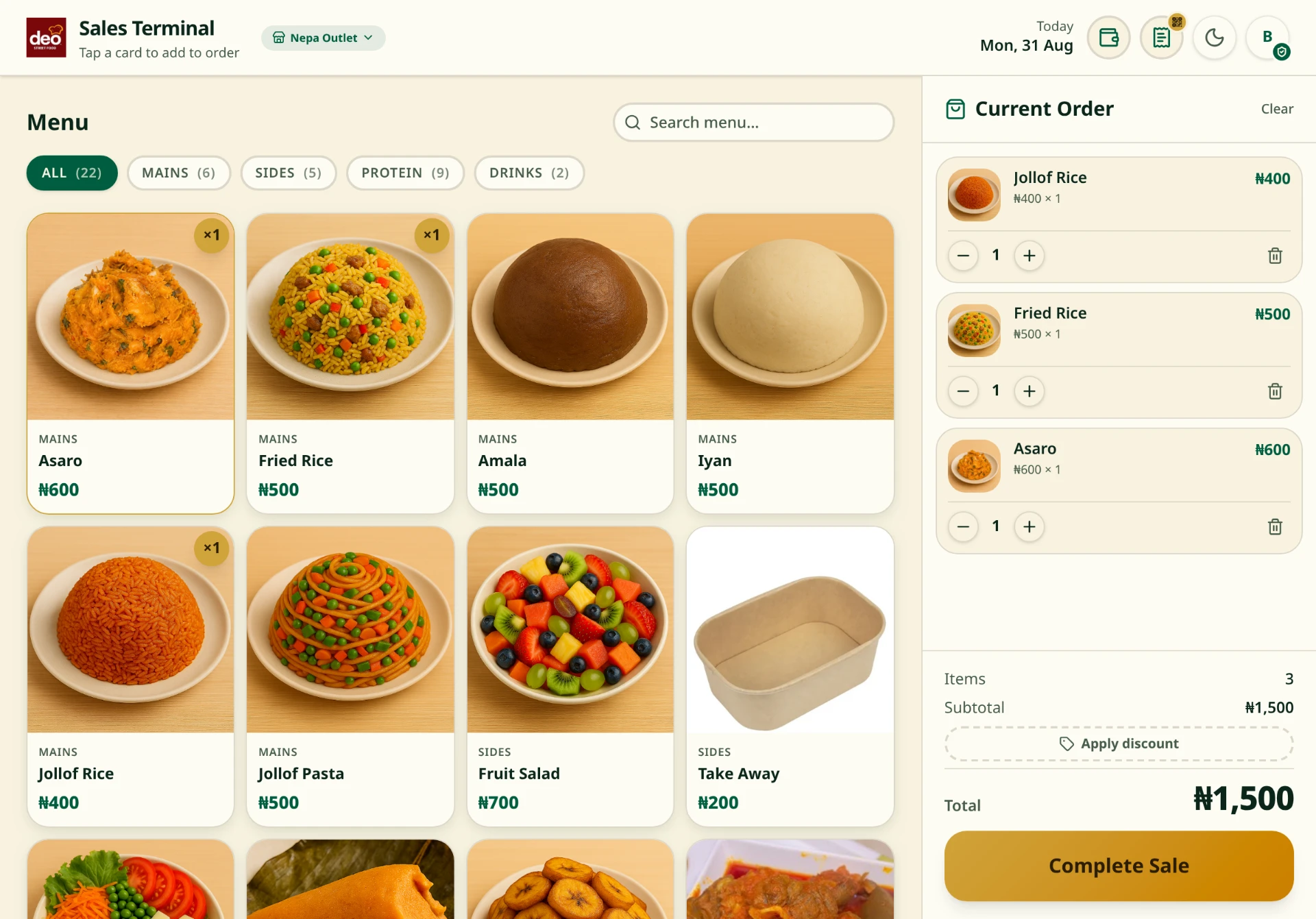
Live product capture
Tablet sales terminal, live outlet session
Cashier view: menu grid, current order and total, running at the Nepa outlet.
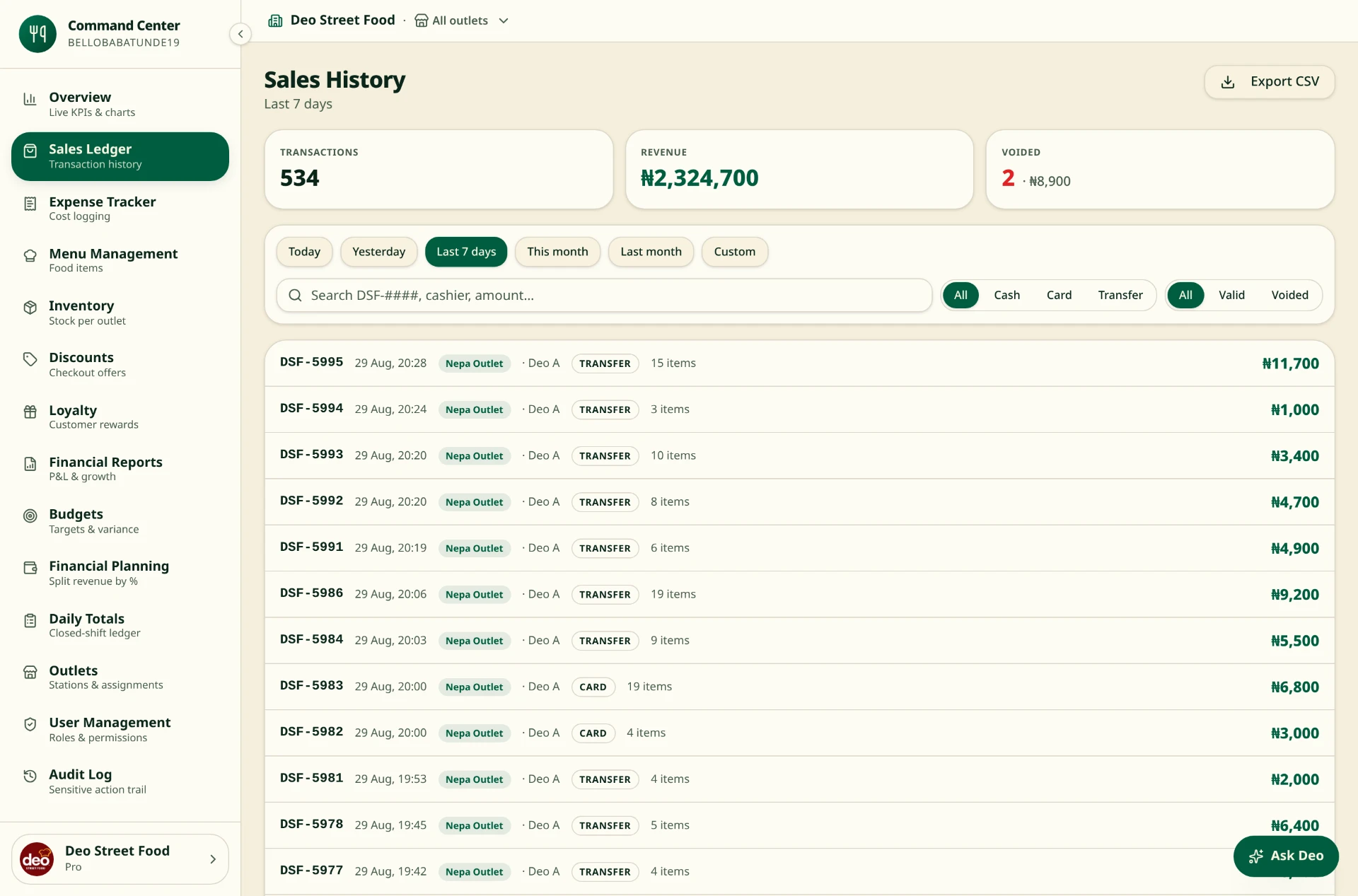
Live product capture
Sales ledger — transaction history across outlets
534 transactions over seven days with payment-method and voided-sale filters.
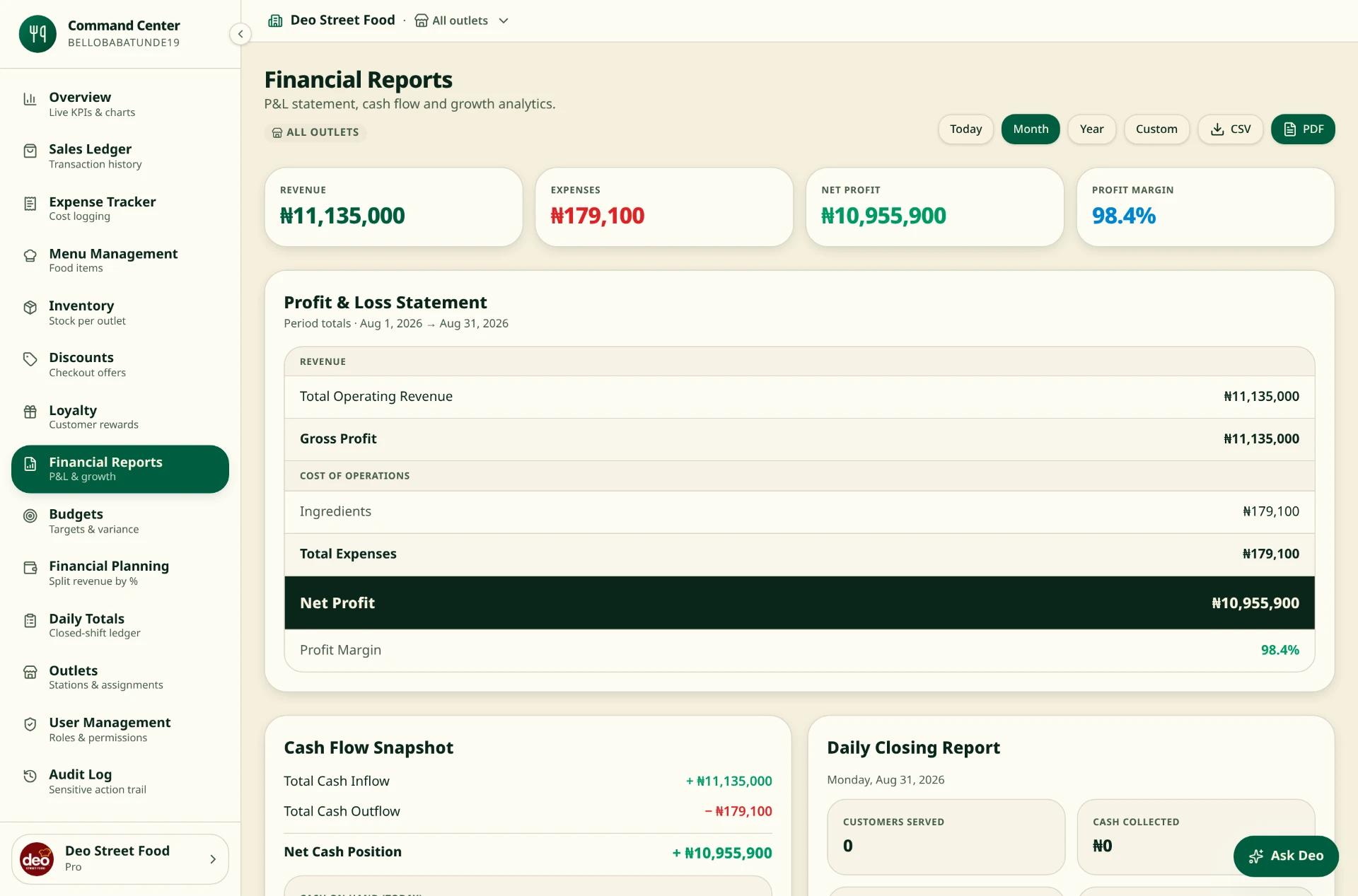
Live product capture
Financial reports — P&L and cash flow
Period P&L, cash-flow snapshot and daily closing report with CSV/PDF export.
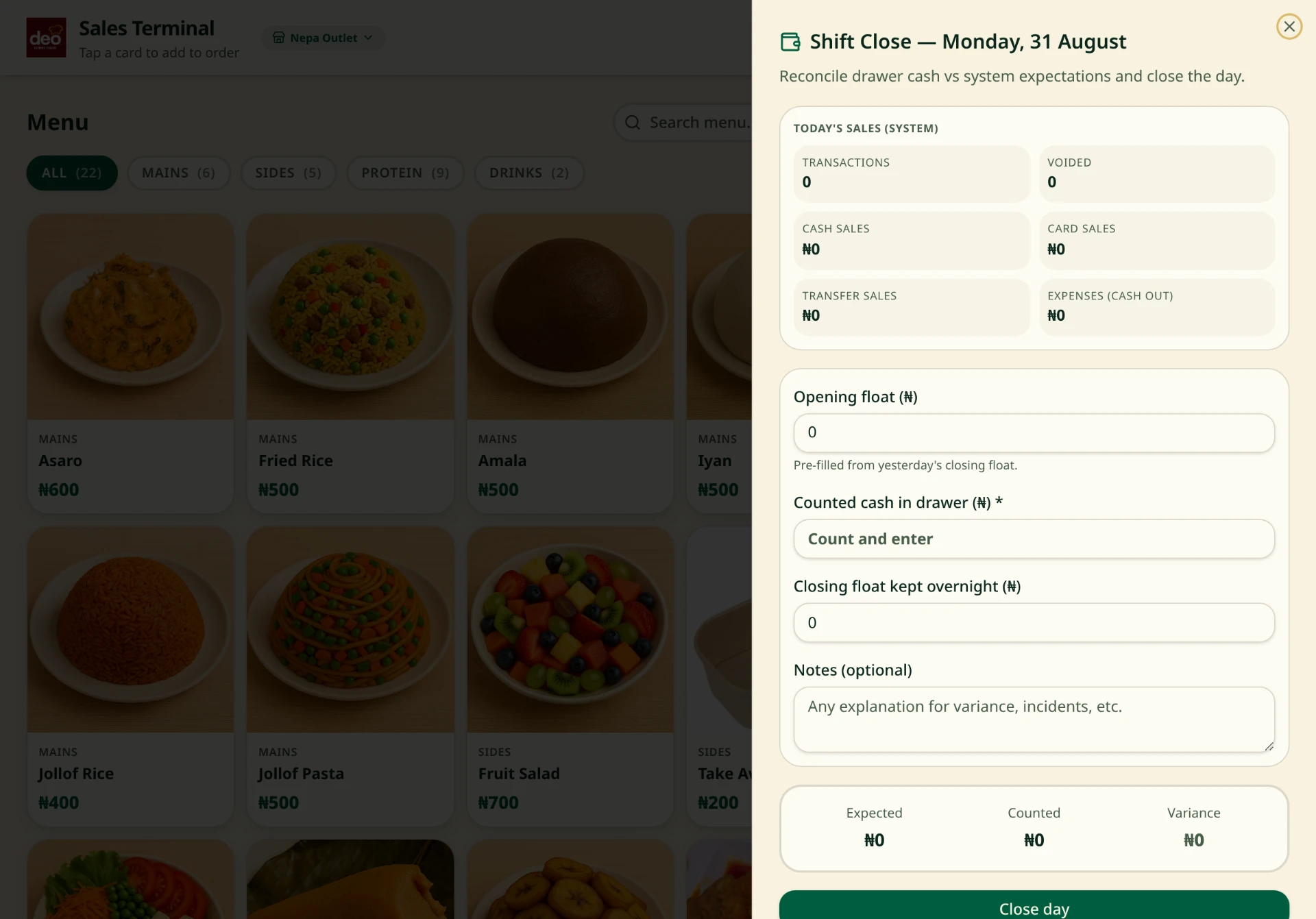
Live product capture
Shift close and cash reconciliation
Drawer count against system expectation, with variance and closing float carried forward.
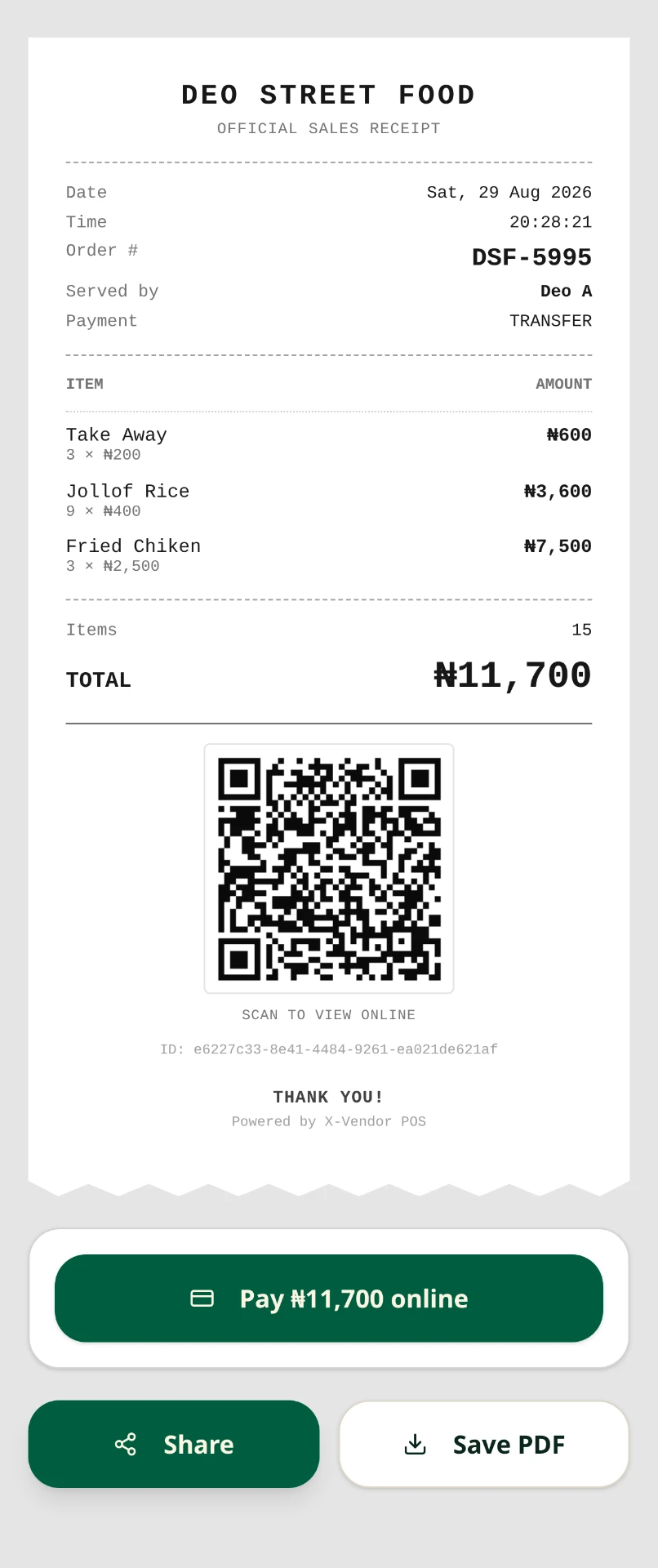
Live product capture
QR receipt as seen by a customer
Itemised digital receipt with online payment, share and PDF options.
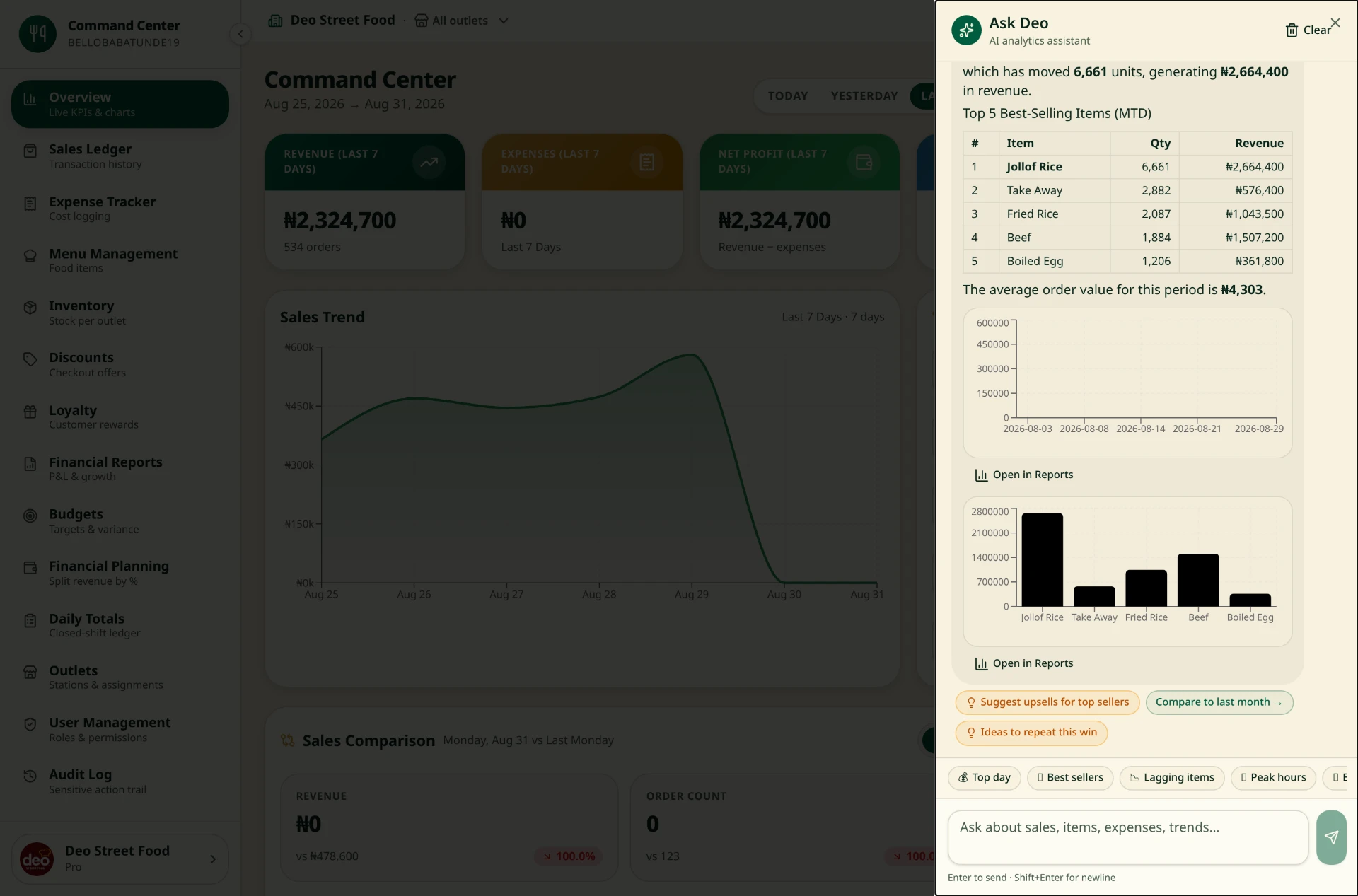
Live product capture
Owner dashboard with the AI analytics assistant
“Ask Deo” answering a best-sellers question against live sales data.
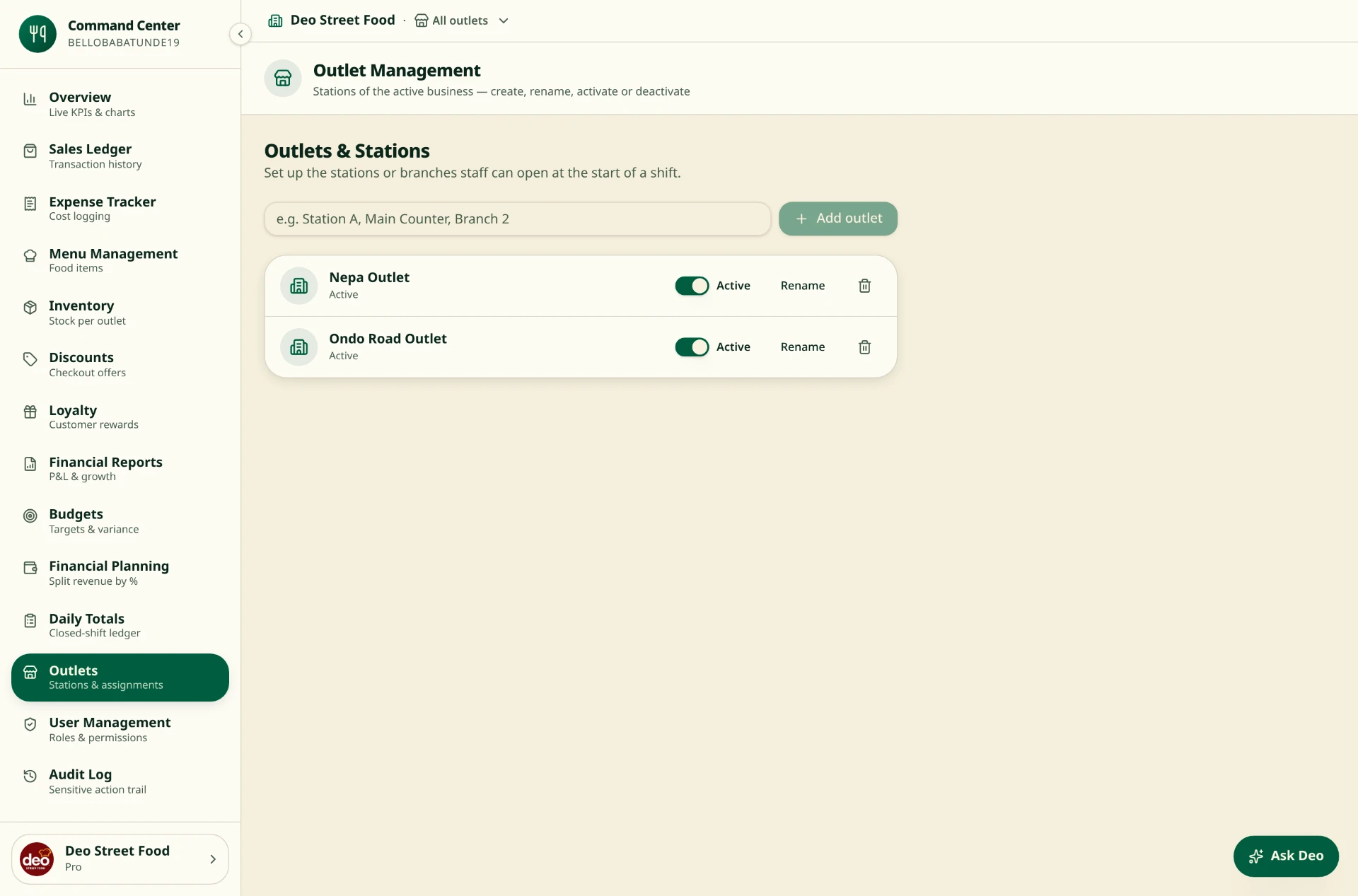
Live product capture
Multi-outlet tenant configuration
Stations and branches a tenant can create, rename and activate per shift.
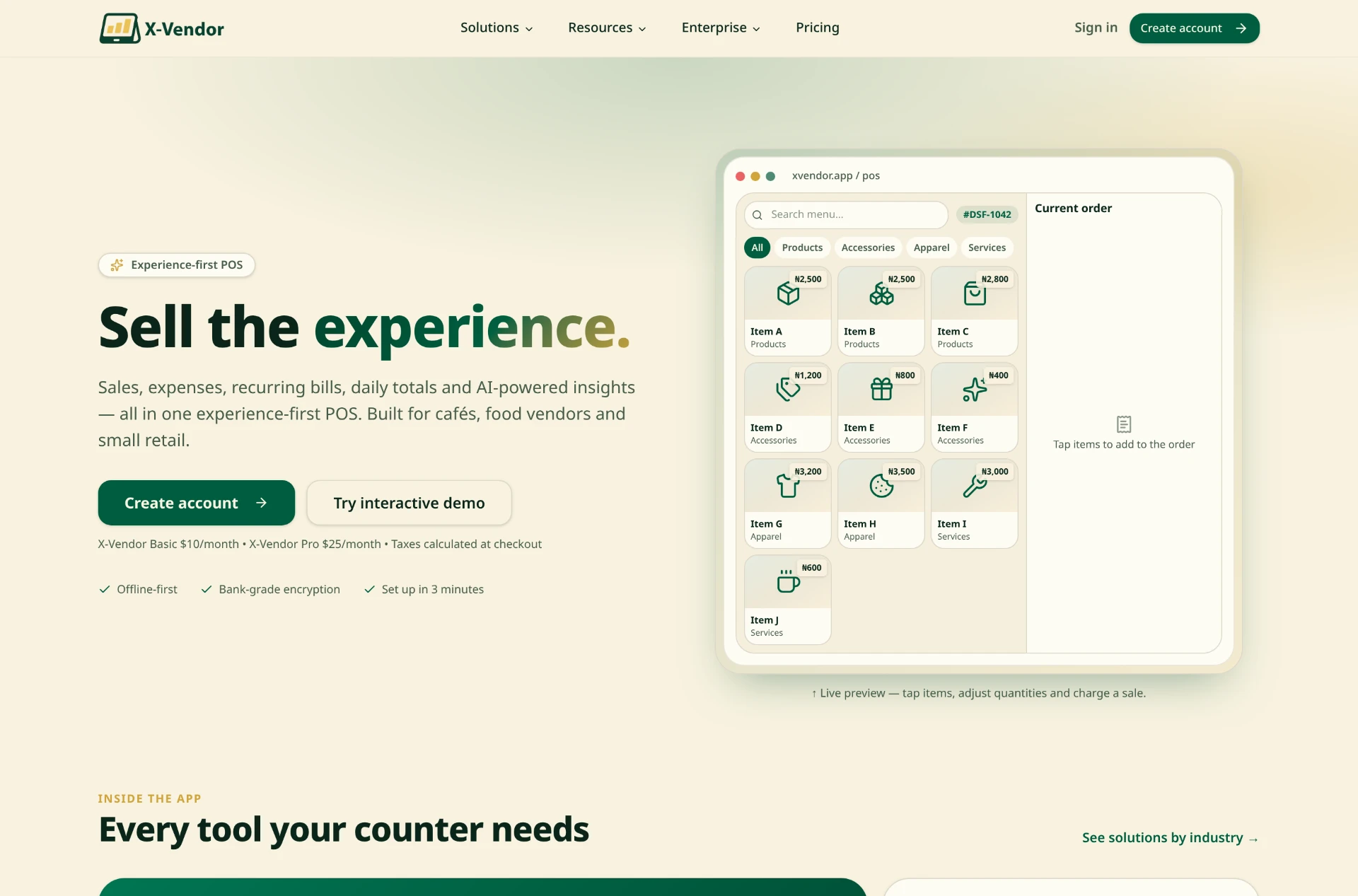
Live product capture
X-Vendor public product site
Commercial positioning and interactive demo at xvendor.com.
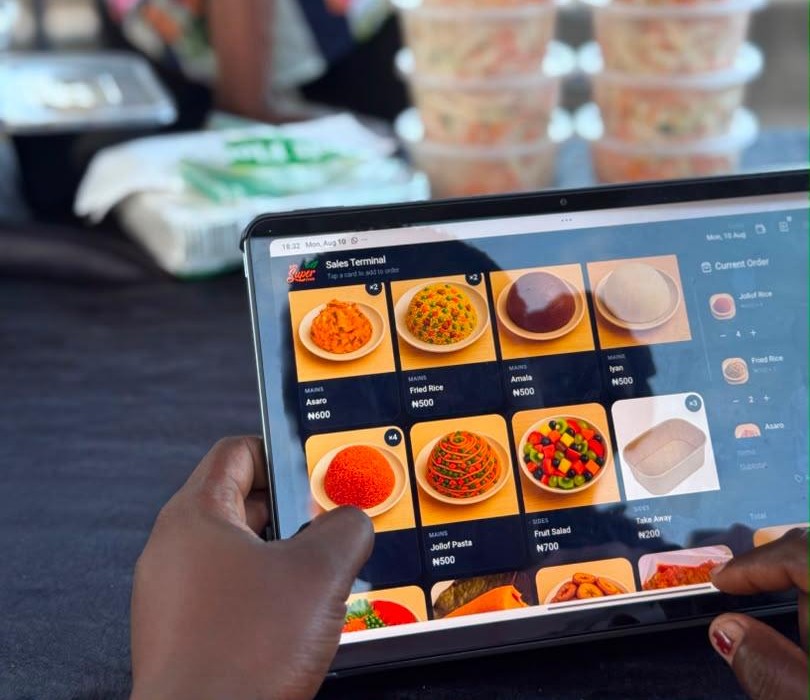
Live product capture
Vendor session, live trading
Field photograph of the terminal in use during service.
Measurement & evidence planThe measures being put in place so outcomes can be reported with confidence rather than estimated.11 items
- Number of businesses actively using the platform
- Number of outlets
- Number of staff users
- Orders processed
- Time saved in daily reconciliation
- Reduction in missing or incorrect ledger entries
- Customer and owner testimonials
- Screenshots of early and current versions
- Founder interview notes
- Product analytics
- Subscription conversion and commercial data when available
13
Lessons
Context can matter more than copying standard POS patterns — the reference designs assumed infrastructure this business did not have.
Infrastructure constraints drove better product decisions. Removing the printer was a constraint before it was a feature.
A focused MVP revealed a larger market opportunity: solving one business's problem properly is what attracted others.
Product architecture has to evolve when the target customer changes from one business to many.
AI-assisted development speeds up delivery, but product judgement, validation and ownership remain human responsibilities.
14
Next steps
The roadmap follows the questions vendors keep asking that the product cannot yet answer.
- Structured evidence capture: instrumented usage so outcomes can be reported with confidence.
- Stock and wastage tracking tied to the existing item catalogue.
- Cross-outlet comparison views for multi-location tenants.
- Formalised onboarding so a new tenant can self-serve without a walkthrough.
Instrument product analytics
Event tracking across the sales, ledger and dashboard flows so outcomes can be reported with confidence.
Structured SME interviews
Interviews across different SME categories to test how far the pain point generalises.
Validate pricing
Test willingness to pay and where the free tier should stop.
Formalise role-based permissions
Explicit owner, manager and staff roles with scoped access.
Strengthen offline-first behaviour
Harder guarantees on queueing and sync resilience under power and signal loss.
Clearer onboarding
Self-serve setup for a new business and for additional outlets.
Exportable financial and ledger reporting
Reports an owner or accountant can take away.
Security, privacy and support model
Define controls, data handling and an operational support path before wider rollout.
Define the metric set
Activation, retention, orders per outlet, reconciliation time and conversion to paid plans.