Product Creator & AI-Assisted Builder
ExamMaster
A Peer-Validated Learning PWA Used by 30+ Computer Science Students
User-tested MVP / peer-validated learning product
A module-based exam-preparation PWA that consolidated learning material, practice questions, progress tracking and revision into one place. More than 30 Computer Science classmates used it heavily during exams and gave strong positive qualitative feedback.
Visit learn-distro-spark.lovable.app- Role
- Product Creator & AI-Assisted Builder
- Users
- 30+ classmates
- Surface
- Browser-first PWA
- Validation
- Qualitative peer adoption
01
Context
In the final year of my Computer Science degree, module material lived across lecture slides, notes, recordings and course resources. Preparing to revise meant switching between sources, reorganising content by hand and hunting for enough practice material to actually test understanding.
I built ExamMaster for my own revision first, then shared it with classmates. It became the revision hub for more than 30 peers during the exam period.
02
How might we reduce the friction between content and practice?
The framing I worked to was: how might we reduce the friction between course content and active exam practice, so students spend more time learning and less time organising revision material?
That broke down into five separate problems, only one of which was about storing content.
- Fragmentation — material was distributed across multiple files and learning systems.
- Passive revision — reading slides did not produce enough active recall or practice.
- Progress visibility — students could not see what they had covered and what remained.
- Exam readiness — students needed practice resembling the demands of testing, not a content repository.
- Time pressure — final-year students needed something immediately useful, not another platform to configure.
03
Users and stakeholders
The first user was me. The product only became interesting when people who had not built it started using it voluntarily.
- Primary — final-year Computer Science classmates preparing for exams, and myself as the original user.
- Potential future users — students on other modules and courses, and learners preparing for professional certifications or interviews.
- Stakeholders — students whose module material is represented in the app, and the course context. ExamMaster was a student-created revision aid, not an official university learning platform.
- Job to be done“When revision materials are scattered, I need one place to see what belongs to a module so I can start studying quickly.”
- Job to be done“When I think I understand a topic, I need questions that test recall so I can discover what I actually know.”
- Job to be done“When exams are approaching, I need visible progress so I can decide where to spend my remaining study time.”
- Job to be done“When I finish a topic, I need to move naturally into practice rather than rebuilding my own quiz from notes.”
- Job to be done“When I return later, I need the learning structure to feel familiar so I can continue without re-orienting myself.”
04
Discovery started with my own revision workflow
This was founder-as-user discovery rather than a theoretical persona exercise. I experienced the friction directly, built for it, then let peer use tell me whether the problem was mine alone or the cohort's.
Every expansion after the first module was driven by watching how classmates used it and what they asked for next.
- 01Experience revision friction
- 02Consolidate module content
- 03Add question bank
- 04Add progress and practice flow
- 05Use it personally
- 06Share with classmates
- 07Observe peer use and collect feedback
- 08Iterate
05
Designing for students under time pressure
The hardest constraint was timing: a revision product is only valuable during a narrow window, and it competes with the exams it is meant to support.
Useful inside an active exam period
The product had to deliver value in the same weeks students were revising. A slow rollout would have missed its own window.
No patience for onboarding
Students would not tolerate setup, configuration or account creation before seeing whether the product helped.
Uneven content volume by module
Some modules carried far more material than others, so the structure had to hold at both extremes.
Support the course, don't impersonate it
Content had to be organised without pretending to replace the lecturer or the official course source.
Questions need module and topic context
A question detached from its module is noise. Every item had to sit inside a recognisable structure.
Laptop and mobile in the same product
Revision moved between desk sessions and short phone sessions, so the interface had to work in both without a separate build.
Informal, qualitative validation
Peer validation was real but uncontrolled — feedback from classmates, not an education study with a design and a control group.
Maintainable during final-year coursework
I was sitting the same exams. Anything too complex to maintain would have been abandoned mid-term.
06
Product decisions and rationale
Most of these decisions traded feature richness for speed of orientation, because that is what the user actually lacked.
Decision 1
Organise around modules, not a generic question feed
Rationale — The user's mental model during exam preparation is “what do I need to know for Distributed Programming?”, not “give me random questions”.
Decision 2
Combine content and practice in one learning hub
Rationale — Switching between lecture material, notes and self-testing was the friction. Removing the switch was the product.
Decision 3
Make practice volume visible on the module card
Rationale — Showing question counts and week coverage lets a student judge breadth and choose where to focus before opening anything.
Decision 4
Add progress tracking
Rationale — Revision is a multi-session activity. Students need continuity and a record of what they have already covered.
Decision 5
Keep the interface card-based and scannable
Rationale — Under exam pressure a student should recognise a module and resume in seconds rather than learn an LMS hierarchy.
Decision 6
Build as a PWA and browser-first experience
Rationale — No install friction, and sharing the product with a classmate is just sending a link.
Decision 7
Share the MVP early with peers
Rationale — Classmates facing the identical revision problem were the fastest way to find out whether the product worked beyond my own workflow.
Decision 8
Treat positive peer use as validation, not causality
Rationale — Adoption and qualitative usefulness are claimable. Grade improvement is not attributable without a proper study.
07
MVP scope
One module, done properly, released to a handful of students. Coverage only expanded once that module was being used without prompting.
In the user-tested MVP
- Module cards and module selection
- Consolidated learning structure per module
- Question banks with module and topic context
- Progress tracking across sessions
- Practice and revision flow
- Practice tests where supported by the product
- Browser and PWA access with no install step
- A multi-module learning hub rather than a single-course prototype
Deliberately not required
- University LMS integration
- Lecturer or admin authoring workflows
- Formal assessment submission
- Grade prediction
- An AI tutor making unsupported academic claims
- Social feed or community features
- Complex gamification
- Enterprise analytics
Stage 0
My own revision problem
Material scattered across slides, notes and resources, with no practice layer.
Stage 1
Consolidate one module
A single module structured properly, to test whether the organisation held.
Stage 2
Add the question bank
Practice questions attached to module and topic, turning content into recall.
Stage 3
Progress and practice flow
Coverage tracking so a multi-session revision plan had continuity.
Stage 4
Personal use under real pressure
I revised with it myself before asking anyone else to rely on it.
Stage 5
Share with classmates
A link, no accounts, no onboarding. Adoption spread by recommendation.
Stage 6
Iterate on peer feedback
Thin modules and wrong answers were reported directly and fixed quickly.
Stage 7
Expand to multiple modules
Reusing the content structure across modules rather than rebuilding per course.
08
AI-assisted delivery, stated plainly
I started with my own revision workflow, defined the module structure, learning flow, question and practice experience and the progress model, then used AI-assisted development tools to accelerate implementation.
I tested the product myself, shared it with classmates and iterated around what made revision faster and easier to navigate. AI also helped draft practice questions at volume, but questions were checked against module material before reaching another student — in a learning product, an incorrect answer costs more credibility than a missing feature.
The product problem, information architecture, learning flow, content organisation, prioritisation, testing and iteration were mine.
09
The product in use
The interface story is short by design: choose a module, review the structured material, answer practice questions, see progress, take a practice run, then return to the weak areas.
Module cards carried the practice volume and week coverage on the face of the card, so a student could judge scope before committing attention.
- Distributed Programming — 200 questions, 10 weeks.
- Cloud Computing — 200 questions, 10 weeks.
- Bloomberg Market Concepts — 160 questions, 8 weeks.
- Product Management — 240 questions, 12 weeks.
- These are documented examples from the captured version of the product; the live build may since have changed.
Progressive web application
Browser-first access with home-screen installability and no app-store step.
Responsive module dashboard
Card-based module selection carrying question volume and week coverage.
Structured module and content model
A repeatable schema for module, topic and material so new modules are additive.
Question-bank layer
Questions bound to module and topic so practice always carries its context.
Progress and state persistence
To verifyCoverage retained between sessions so students resume rather than restart.
Practice-test flow
To verifyA timed or grouped run over a module's questions rather than single-item drilling.
Backend, storage and authentication
To verifyPersistence and account handling in the current build are not confirmed here and need verification against the live codebase.
AI-assisted implementation workflow
Specification, structure and review by me; implementation accelerated with AI development tools.
10
Validation and outcomes
More than 30 Computer Science classmates used ExamMaster heavily during final-year exam preparation. Adoption was voluntary and spread by peer recommendation, which is the signal I trust most here.
Feedback was strong and qualitative: usefulness, clarity and how much it helped structure revision. Peer use proved the problem extended beyond my own workflow, and the product held up across several modules rather than a single-course prototype.
What I cannot claim: any causal link to grades, pass rates or exam performance. That would need a study I did not run.
Voluntary adoption
30+ Computer Science classmates used ExamMaster during final-year exam preparation, with no requirement or incentive to do so.
Peer recommendation as distribution
Growth came from students telling other students, not from promotion — the cheapest honest signal that a product is useful.
Qualitative feedback
Feedback centred on usefulness, clarity and how much easier the product made it to structure revision.
Generalised beyond one course
The structure supported several modules, showing the problem was the workflow rather than one syllabus.
30+
Computer Science classmates using it during exam preparation
Simulated
Multi-module
Coverage across several modules, not a single course
Simulated
Adoption and qualitative feedback are the verified signals. No grade, pass-rate, retention, session or completion figures are claimed — usage analytics were not instrumented at the time.
11
Product management competencies
What this project demanded of me as a product person, rather than what the product contains.
- Founder-as-user discovery
- Problem framing
- Information architecture
- Learning-product UX
- MVP definition
- Feature prioritisation
- Content and product structuring
- Progress-state design
- Rapid prototyping
- Peer user testing
- Qualitative feedback synthesis
- Adoption validation
- Iterative delivery
- Scope control
- Responsible outcome claims
12
Evidence gallery
Captured from the live product. These are real screens, not reconstructions.
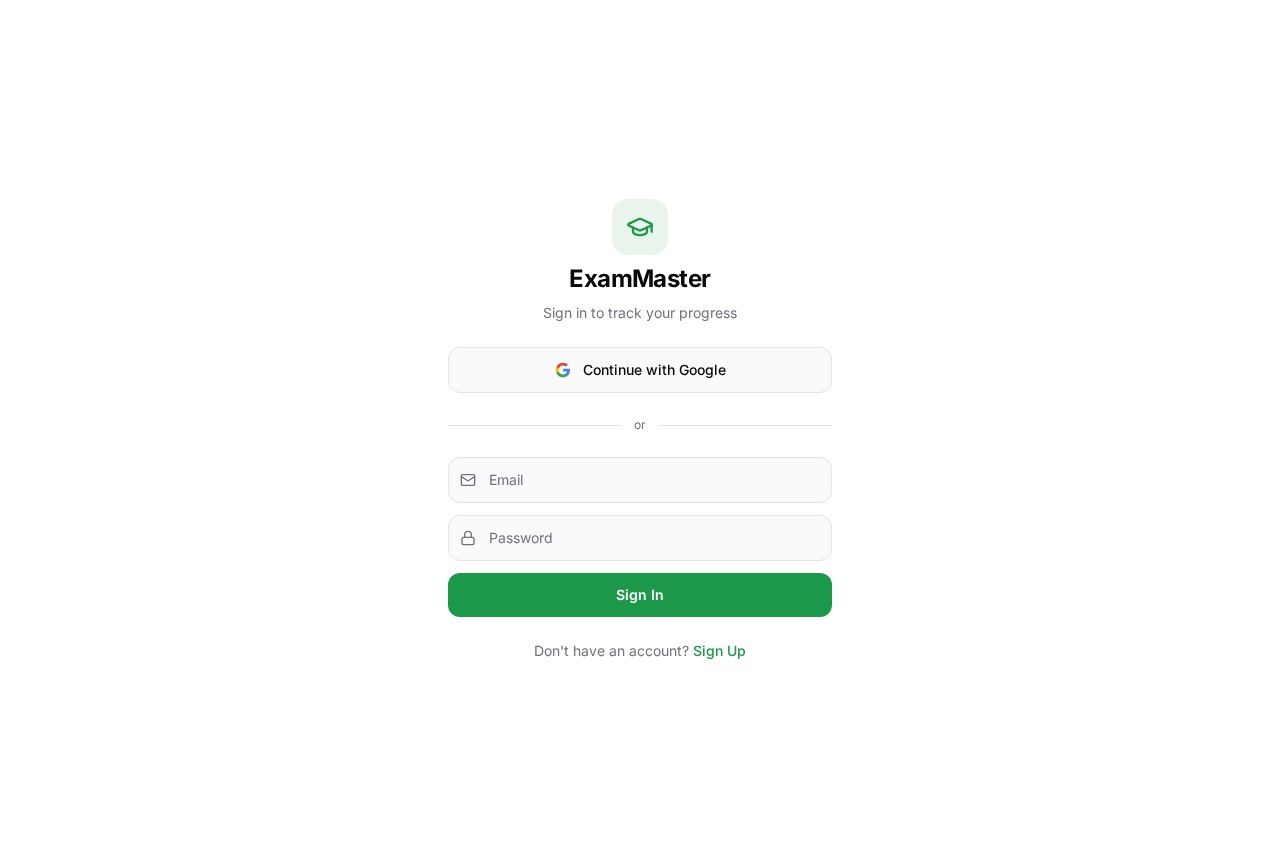
Live product capture
ExamMaster sign-in — the live product entry point
Captured from the running product. Everything past this screen is account-gated, so no in-app screens are shown rather than reconstructed ones.
learn-distro-spark.lovable.app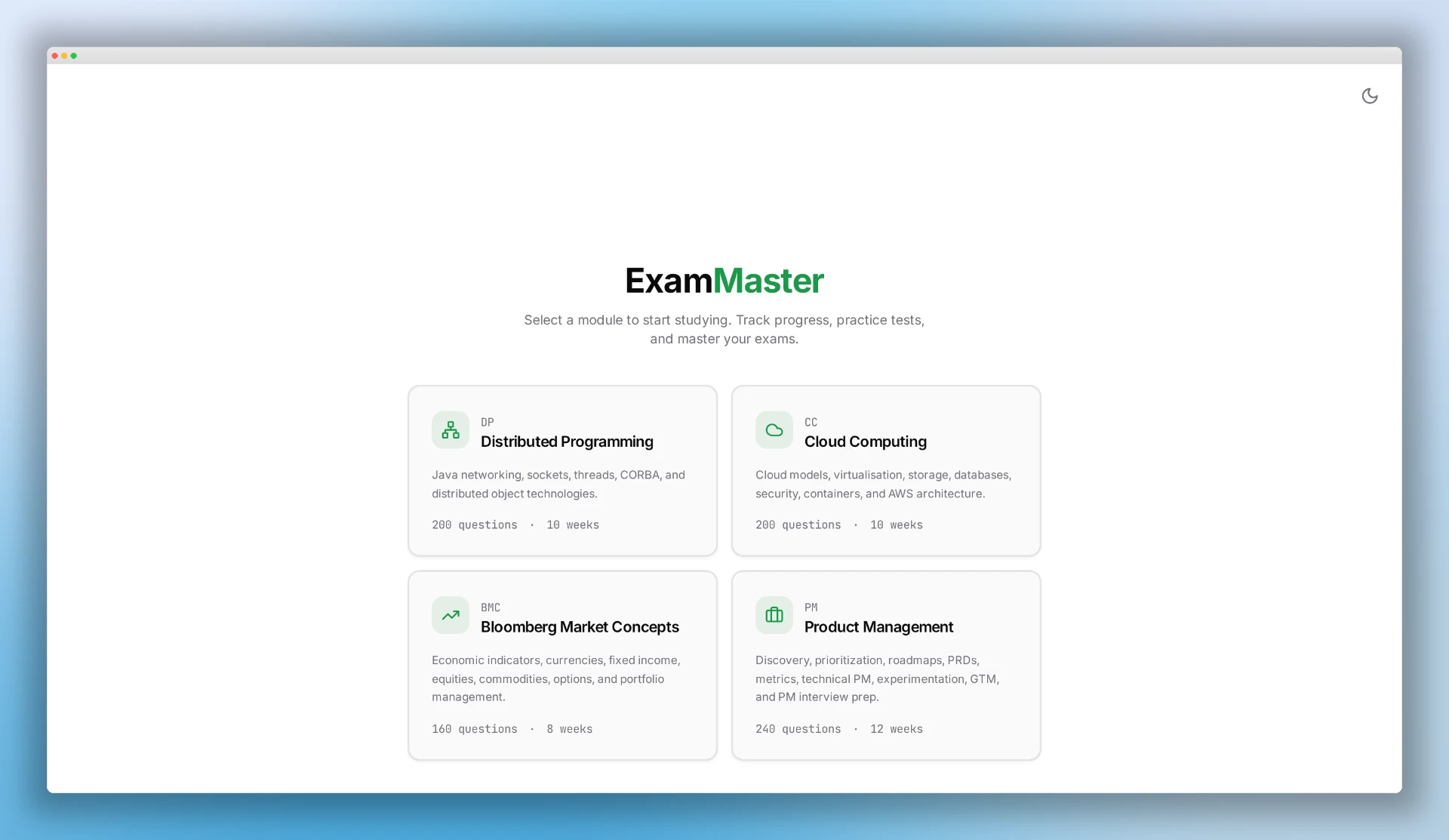
Live product capture
Module selection — the four live question banks
Real capture: Distributed Programming, Cloud Computing, Bloomberg Market Concepts and Product Management, each with question count and week structure.
Live product capture
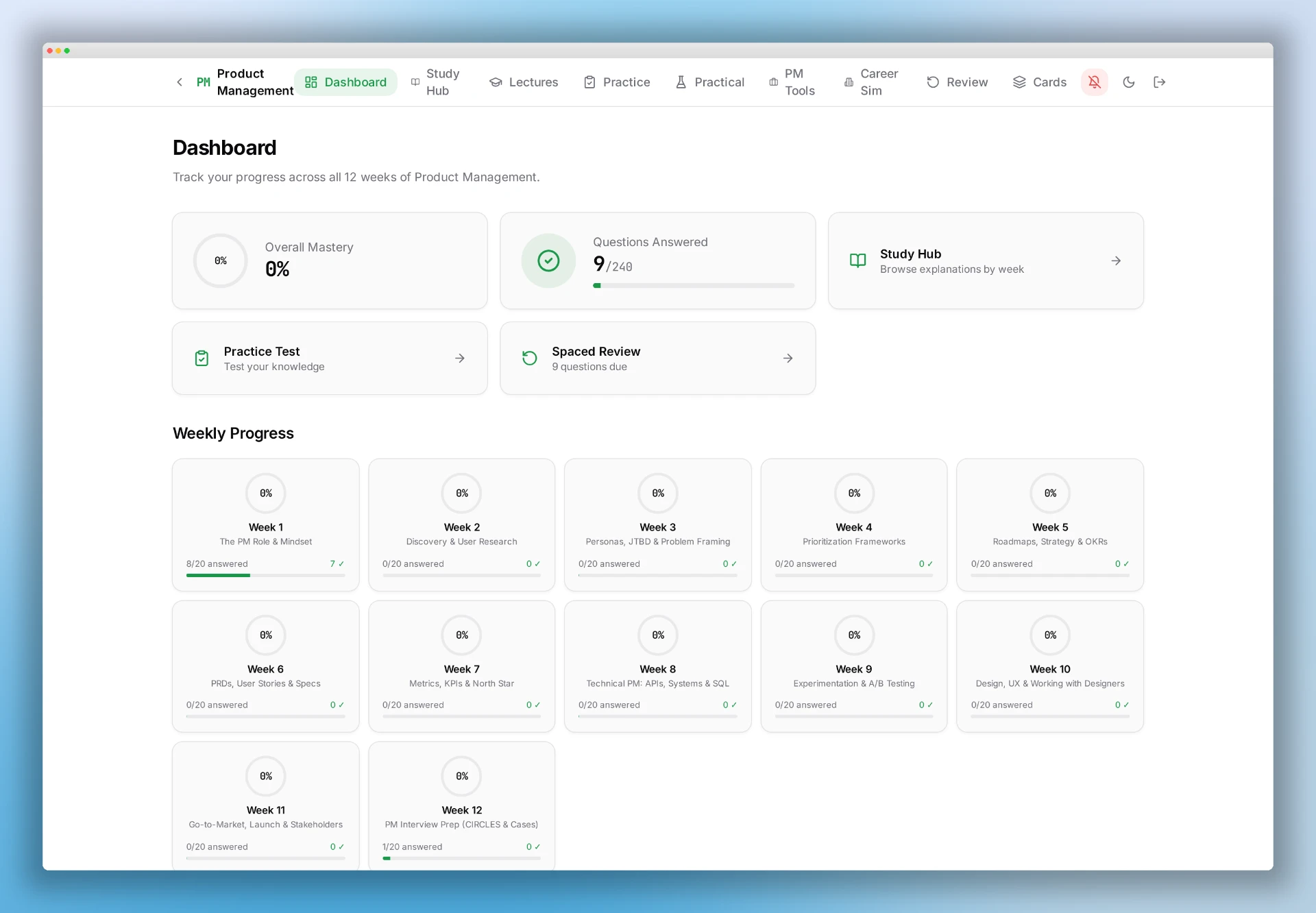
Module dashboard — mastery and weekly progress
Real capture: overall mastery, questions answered, spaced review queue and per-week progress across the 12-week structure.
Live product capture
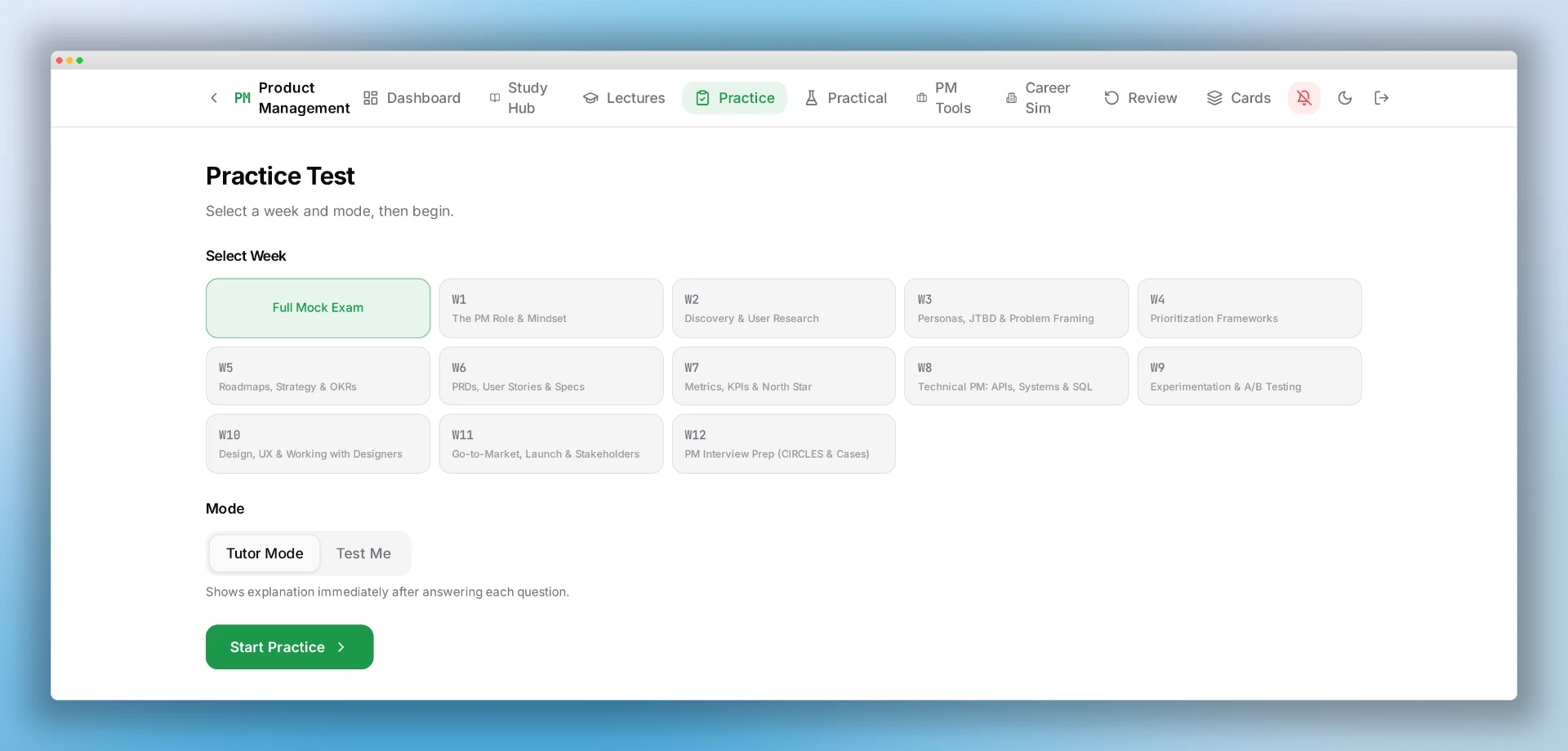
Practice test setup — week and mode selection
Real capture: learners pick a full mock exam or a single week, then choose Tutor Mode (immediate explanations) or Test Me.
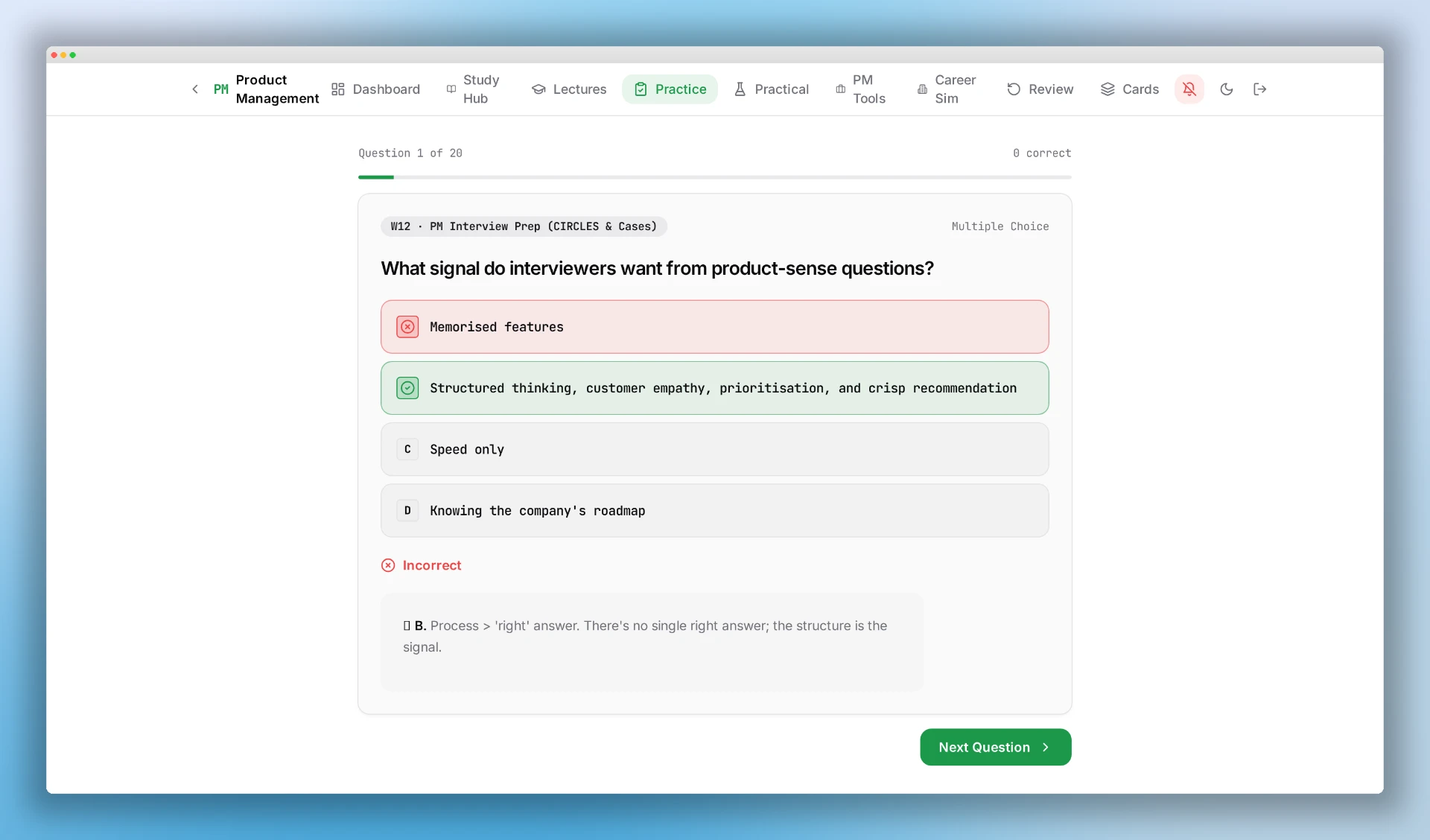
Live product capture
Question and explanation flow
Real capture: answer feedback with the correct option highlighted and the reasoning shown immediately in Tutor Mode.
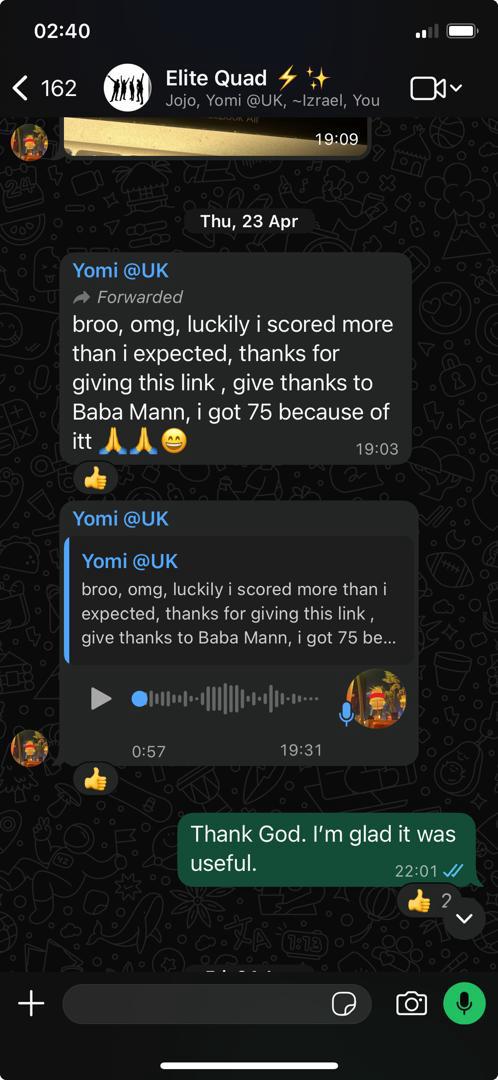
Live product capture
Anonymised peer feedback
Real WhatsApp message from a classmate who used the shared ExamMaster link: scored 75 and credited the resource. Names and avatars removed.
Measurement & evidence planThe measures being put in place so outcomes can be reported with confidence rather than estimated.12 items
- Screenshots of the original module dashboard
- Screenshots of the question and practice flows
- Anonymised student feedback and messages
- Number of unique students who used the product
- Usage sessions and analytics if recoverable — none are currently instrumented
- Most-used modules
- Questions attempted and practice tests completed, if recoverable
- Repeat usage across the revision period
- Before-and-after comparison of students' revision workflow
- Examples of changes made in response to peer feedback
- Product and version history
- Any source artefacts suitable for public sharing
13
What I learned
A problem I experience personally is a useful starting point, but other users decide whether it is a product opportunity.
Students under time pressure value fast orientation and continuity far more than feature richness.
Active practice is what turns a content repository into a learning workflow, and visible progress is what gives users a reason to come back.
Sharing an imperfect MVP early taught me more than polishing privately would have. Adoption and positive feedback are meaningful signals — they are still not proof of academic improvement.
Reusable content structures are what make it cheap to go from one module to many.
14
Limitations
Stating these plainly is part of the work. These are the boundaries of what the evidence here can and cannot support.
- Peer validation was informal rather than a controlled usability or education study.
- 30+ adoption is known, but deeper usage analytics were never instrumented or documented.
- There is no causal evidence linking ExamMaster usage to final grades.
- Content quality depends on the source material and the question generation and review process.
- The MVP was built for one cohort and context, not validated across universities.
- Long-term retention and repeat use beyond the exam window were not measured.
- Lecturer and institutional workflows were never part of the original product.
15
What I would do next
The gap is measurement. Adoption is known; behaviour is not.
Instrument event analytics and repeat use
The single biggest gap: adoption is known, behaviour is not.
Recover historical usage where possible
Document what the original cohort's use actually looked like.
Run structured student interviews
Replace informal feedback with a repeatable research process.
Measure task success and study-session behaviour
Understand where students stall inside a revision session.
Topic-level mastery views
Progress by topic rather than by module, so weak areas surface themselves.
Spaced repetition and adaptive practice
Introduced carefully, since scheduling changes how students trust the product.
Question-quality review workflow
A defined review step before any question reaches a student.
Weak-area recommendations from real performance data
Personalisation grounded in attempts, not assumptions.
Test outside the original cohort
Validate with students who did not know the person who built it.
Authoring and import workflow for new modules
Make module creation a supported action rather than a manual build.
AI study companion with source grounding
Only with explicit citation to module material and hallucination safeguards.
Test professional learning and interview preparation
Evaluate as a separate segment with its own economics, not an extension by default.
16
What the product actually was
ExamMaster taught me that the reusable product was not a specific Computer Science question bank; it was the structure for turning fragmented learning material into a guided practice experience.
That insight later influenced experiments around AI-curated Product Management learning, lecture and video resource curation, and interview preparation. Those are a future product direction and a product insight — not part of the validated ExamMaster MVP.