Product Creator, Researcher & Developer
Rescuify
Designing a trust-verified, AI-assisted food surplus redistribution platform
Final-year research prototype / simulation — not a production deployment
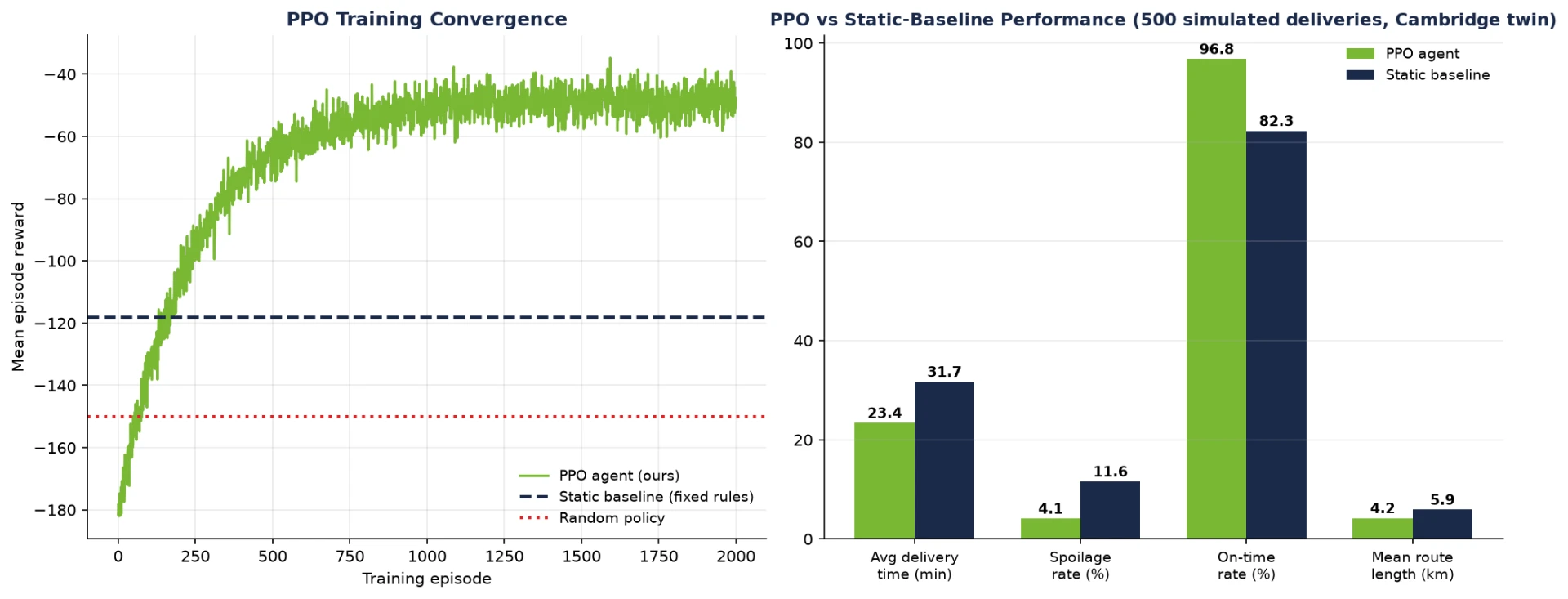
Designed and evaluated a multi-stakeholder platform exploring how adaptive routing, cold-chain monitoring and tamper-evident traceability could improve perishable food redistribution. In the Cambridge simulation the system recovered 27 of 30 injected thermal breaches and produced a 98.0% simulated waste-diversion rate against an 80.0% static-routing baseline. All figures are simulated experimental results.
Visit rescuify.com- Role
- Product Creator, Researcher & Developer
- Basis
- Dissertation, ARU — awarded 87%
- Evidence
- Simulated / experimental only
- Stack
- React, FastAPI, PPO, OSMnx, SHA-256
01
Context
My final-year dissertation, “Decentralized Food Surplus Redistribution Platform using Blockchain and Reinforcement Learning” (Anglia Ruskin University, submitted 22 April 2026, awarded 87%), started from a systems problem rather than from a technology I wanted to use.
Edible surplus and food insecurity coexist in the same cities. The barriers between them are interconnected: manual last-mile routing, spoilage risk during redistribution, weak cold-chain monitoring, donor liability and compliance concerns, thin end-to-end traceability and low recipient trust — and, underneath all of it, fragmentation between the logistics, sensing and trust systems that would have to cooperate.
The product hypothesis was that these are not separable features. Rescuify explored whether routing intelligence, IoT-style condition monitoring and cryptographic traceability could operate as one coordinated cyber-physical platform.
02
The product problem
Redistributing perishable surplus is a decision problem under uncertainty where the cost of a wrong decision is not inefficiency but unsafe food. A static plan cannot answer what should happen when a chilled load warms mid-route.
At the same time, none of the logistics intelligence matters if a donor cannot show what happened to the food they gave away, or a recipient cannot check it.
- Surplus is lost while demand for it goes unmet, because coordination cost exceeds value before the food fails.
- Last-mile routing is manual and static, so it cannot respond to changing conditions.
- Cold-chain condition is largely unobserved during redistribution.
- Donors carry liability with no defensible record of handling.
- Recipients are asked to trust an opaque chain of custody.
03
Users & stakeholders
The dissertation implemented role-based interfaces because each role carries a different task, a different risk and a different trust requirement.
- Food donor — registers surplus; needs confidence around safety, accountability and handoff.
- Driver — receives tasks and routes; needs live condition and risk information while carrying perishable food.
- Recipient — receives food; needs confidence in its condition, history and traceability.
- Administrator — oversees system activity, impact, governance and audit information.
- Wider stakeholders — charities and redistribution organisations, institutional food donors, food-safety and compliance bodies, and researchers or smart-city operators.
- Job to be done“Donor: “When I donate surplus food, I need an auditable record of its condition and handoff so redistribution does not create unmanaged liability.””
- Job to be done“Driver: “When conditions change during a delivery, I need the system to identify risk and adapt the route before food becomes unsafe.””
- Job to be done“Recipient: “When food arrives, I need to verify its handling history rather than simply trust an opaque chain of custody.””
- Job to be done“Administrator: “When I monitor the network, I need to understand what was redistributed, what went wrong and whether records have been altered.””
04
Research-led discovery
Discovery here was research rather than fieldwork: a literature review and an analysis of existing platforms, used to locate system gaps, translate those gaps into stakeholder needs, and then into product requirements before any architecture was drawn.
The dissertation compared Rescuify against Too Good To Go, FareShare and IBM Food Trust on tamper-evident audit trails, RL-based adaptive routing, real-time condition monitoring, institutional redistribution orientation and open-source implementation. Its conclusion was not that any one capability was novel, but that integrating trust, adaptive routing and condition monitoring within a single architecture was.
- 01Literature review
- 02Existing-platform analysis
- 03Identify system gaps
- 04Define stakeholder needs
- 05Convert gaps into requirements
- 06Design prototype architecture
- 07Simulate and evaluate
| Capability | Rescuify | Too Good To Go | FareShare | IBM Food Trust |
|---|---|---|---|---|
| Blockchain audit trail | Yes | No | No | Yes |
| RL-based routing | Yes | No | No | No |
| Real-time IoT monitoring | Yes | No | No | Yes |
| Institutional redistribution | Yes | No | Yes | Yes |
| Open-source | Yes | No | No | No |
Academic feature comparison from the dissertation (Table 4.7); not a current commercial market audit.
05
Requirements & constraints
The constraints below shaped both what the platform had to do and what could honestly be claimed about it.
Perishable food is time-sensitive
Routing quality affects safety, not just efficiency, so the cost function could not be distance alone.
Conditions change mid-route
Static planning cannot answer the research question, because the interesting decisions happen after departure.
Different roles, different permissions
Donors, drivers, recipients and administrators need different information and different levels of access to it.
Trust records must be tamper-evident
An audit trail is only useful in a compliance scenario if alteration can be detected.
Real operational data was scarce
No high-fidelity dataset of urban surplus logistics and spoilage was available, so validation had to be simulation-based and labelled as such.
Components had to be testable in isolation
The system needed to be modular enough to evaluate the RL agent, the telemetry layer and the trust layer separately.
Blockchain deployment was out of scope
The implementation used SHA-256 hashing to simulate immutability and tamper evidence rather than running a production distributed ledger.
Feasibility is not adoption
The evaluation had to separate what the system could technically do from what could be claimed about real-world use.
06
Key product & technical decisions
Each decision below was made against the research question — whether an integrated system could adapt to risk, preserve records and improve simulated diversion — rather than against a feature list.
Decision 1
Multi-role platform rather than one generic dashboard
Rationale — Donors, drivers, recipients and administrators each have different tasks, risks and trust requirements. The dissertation implemented role-based interfaces with access control rather than a single shared console.
Decision 2
PPO reinforcement learning for adaptive routing
Rationale — The research question required dynamic decisions under changing environmental conditions, not a static shortest path. Proximal Policy Optimization via Stable-Baselines3 and Gymnasium gave a stable, well-documented on-policy baseline to experiment with.
Decision 3
A Cambridge digital twin built with OSMnx
Rationale — High-fidelity open data on urban surplus logistics and spoilage was scarce. A stochastic simulation over the real Cambridge street network created a controlled environment where cold-chain breaches could be injected and policies compared fairly.
Decision 4
Simulated IoT thermal telemetry
Rationale — The system needed a condition signal capable of triggering intervention mid-delivery. Software-defined sensors allowed repeatable, reproducible experimentation without deploying physical hardware.
Decision 5
SHA-256 cryptographic persistence layer
Rationale — Tamper-evident audit behaviour could be tested without the cost of a production blockchain network. This simulates immutability; it is deliberately not presented as distributed consensus.
Decision 6
FastAPI orchestration layer
Rationale — Keeping business logic, AI inference, persistence and frontend interaction behind one API boundary meant each could change or be tested without destabilising the others.
Decision 7
Modular four-tier cyber-physical architecture
Rationale — Separating presentation, orchestration, intelligence/monitoring and persistence/trust allowed each tier to be developed and evaluated independently before integration.
Decision 8
Success measured on safety, trust and logistics — not UI completion
Rationale — The hypothesis depended on whether the system could adapt to risk, preserve records and improve simulated waste diversion against a baseline. Those became the evaluation metrics.
07
What the prototype proved, and what it did not
This distinction is the most important part of the case study. The prototype demonstrated technical feasibility inside a controlled simulation; it did not demonstrate operational or commercial viability.
The prototype demonstrated
- An integrated multi-role workflow across donor, driver, recipient and administrator.
- A working reinforcement-learning routing research pipeline.
- Simulated IoT condition monitoring capable of triggering intervention.
- A cryptographic, tamper-evident audit trail.
- A Cambridge geospatial simulation environment.
- Measurable experimental evaluation against a baseline.
- Functioning role-based interfaces.
The prototype did NOT prove
- Real-world charity deployment.
- Real donor or recipient adoption.
- Production-grade blockchain consensus.
- Physical IoT hardware reliability at scale.
- Regulatory or food-safety approval.
- Commercial product-market fit.
- Multi-driver / multi-agent optimisation in live operations.
08
How it was built
This was an academic engineering and research project, not a generated app. The architecture, implementation and simulation are documented in the dissertation and built on FastAPI, Stable-Baselines3, Gymnasium, Supabase, OSMnx and related open-source tooling.
Where AI-assisted tooling was used, it was to accelerate parts of the public-facing UI and portfolio presentation of the work. The research design, system logic, experimental setup, interpretation and dissertation are my own.
09
Architecture
The dissertation used a four-tier cyber-physical architecture so that presentation, orchestration, intelligence and trust concerns could be developed and evaluated independently before integration.
The trust layer used SHA-256 hashing to produce a tamper-evident audit trail simulating blockchain immutability. Hyperledger Fabric appears in the dissertation only as part of the platform-selection rationale; it was not the deployed trust implementation.
Layer 1
Presentation
React role-based interfaces for donor, driver, recipient and administrator, with role-based access control.
Layer 2
Logic / orchestration
FastAPI backend holding business logic, task allocation and the API boundary between interfaces and intelligence.
Layer 3
Intelligence / cyber-physical
PPO reinforcement-learning agent, simulated IoT thermal telemetry and the Cambridge OSMnx digital twin.
Layer 4
Persistence / trust
Relational persistence (Supabase/PostgreSQL) plus a SHA-256 cryptographic audit trail simulating blockchain immutability.
Flow 01
Donation registered
A donor registers surplus; the platform records the item, condition and handling requirements.
Flow 02
Route and task allocated
The platform assigns a collection task and an initial route across the Cambridge network.
Flow 03
Delivery begins with telemetry streaming
Simulated IoT sensors stream condition data for the load throughout the journey.
Flow 04
Risk or breach detected
A thermal excursion is identified against the safety threshold rather than after the fact.
Flow 05
RL agent evaluates and adapts
The PPO agent reassesses the logistics decision under the new conditions and adapts the plan.
Flow 06
State recorded and hashed
The delivery state change is written and a SHA-256 audit event is generated for it.
Flow 07
Recipient and administrator verify
Both can inspect the chain of custody and check that records have not been altered.
React role interfaces with RBAC
Separate donor, driver, recipient and administrator surfaces over shared platform state.
FastAPI orchestration
API boundary between interfaces, AI inference, telemetry and persistence.
PPO agent (Stable-Baselines3 / Gymnasium)
Single-agent policy trained in a custom environment representing the redistribution task.
Cambridge OSMnx digital twin
Real street-network graph used for travel cost, so routing decisions carry realistic distance and time.
Simulated IoT telemetry
Software-defined thermal sensors streaming condition data with injectable breach events.
SHA-256 audit trail
Append-only hashed event chain simulating blockchain immutability; not a distributed ledger.
Supabase / PostgreSQL persistence
To verifyRelational storage for donations, roles, tasks and event records.
Deployment and infrastructure detail
To verifyExact hosting, sync and environment configuration for the public site are implementation details to confirm against the current codebase.
10
How I evaluated the product hypothesis
Evaluation was designed around the hypothesis rather than around interface completion. Every figure below is a simulated or prototype evaluation result: no real food was moved, no physical thermal breach occurred, and no charity deployed the system.
Cambridge OSMnx digital-twin simulation
Stochastic scenarios generated over the real Cambridge street network.
Controlled cold-chain breach injection
Thermal excursions injected deliberately so recovery behaviour could be measured, not observed by luck.
Static-routing baseline comparison
The same scenarios run under a static policy, so the adaptive results have something to be measured against.
PPO agent performance testing
Delivery success and spoilage prevention measured across evaluation episodes.
Audit-trail integrity testing
Deliberate tampering attempts against stored records to test detection.
IoT sensor simulation testing
Telemetry generation and threshold-triggering behaviour verified in isolation.
Role-interface usability evaluation
System Usability Scale administered across donor, driver and recipient interfaces.
27 / 30
Injected thermal breaches rescued in the Cambridge simulation
Simulated
98.0%
Simulated waste-diversion rate
Simulated
80.0%
Static-routing baseline, same scenarios
Simulated
150
Simulated transactions with cryptographic hashes generated
Simulated
Further prototype evaluation results
- 92%PPO evaluation: delivery success rate
- 78%Proactive spoilage prevention in at-risk episodes
- 79.0System Usability Scale — interpreted as good usability
- 100%Tampering detection in the audit-trail integrity test
These are separate evaluation outputs reported in the dissertation, not a single combined experiment. All results come from simulated environments and prototype testing; none describe real-world deployment.
11
Product management competencies
What this project demanded of me as a product person, rather than what the product contains.
- Systems problem framing
- Research-led discovery
- Stakeholder mapping
- Platform gap analysis
- Multi-role product design
- Technical architecture trade-offs
- AI/ML product thinking
- Reinforcement learning experimentation
- IoT / cyber-physical product thinking
- Trust & traceability design
- Metric definition
- Baseline comparison
- Risk and safety thinking
- Usability evaluation
- Responsible claims & limitations
- Future roadmap definition
12
Evidence gallery
Captured from the live product. These are real screens, not reconstructions.
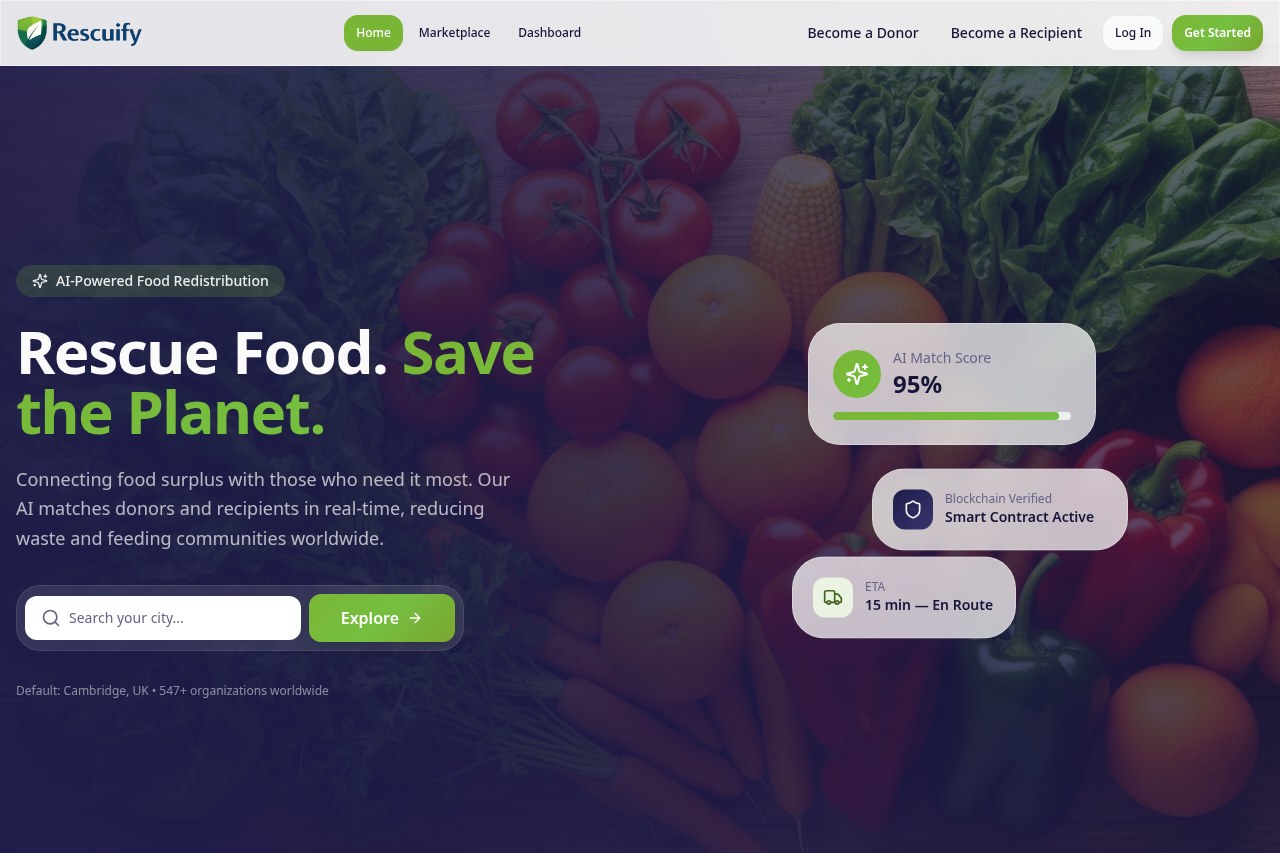
Live product capture
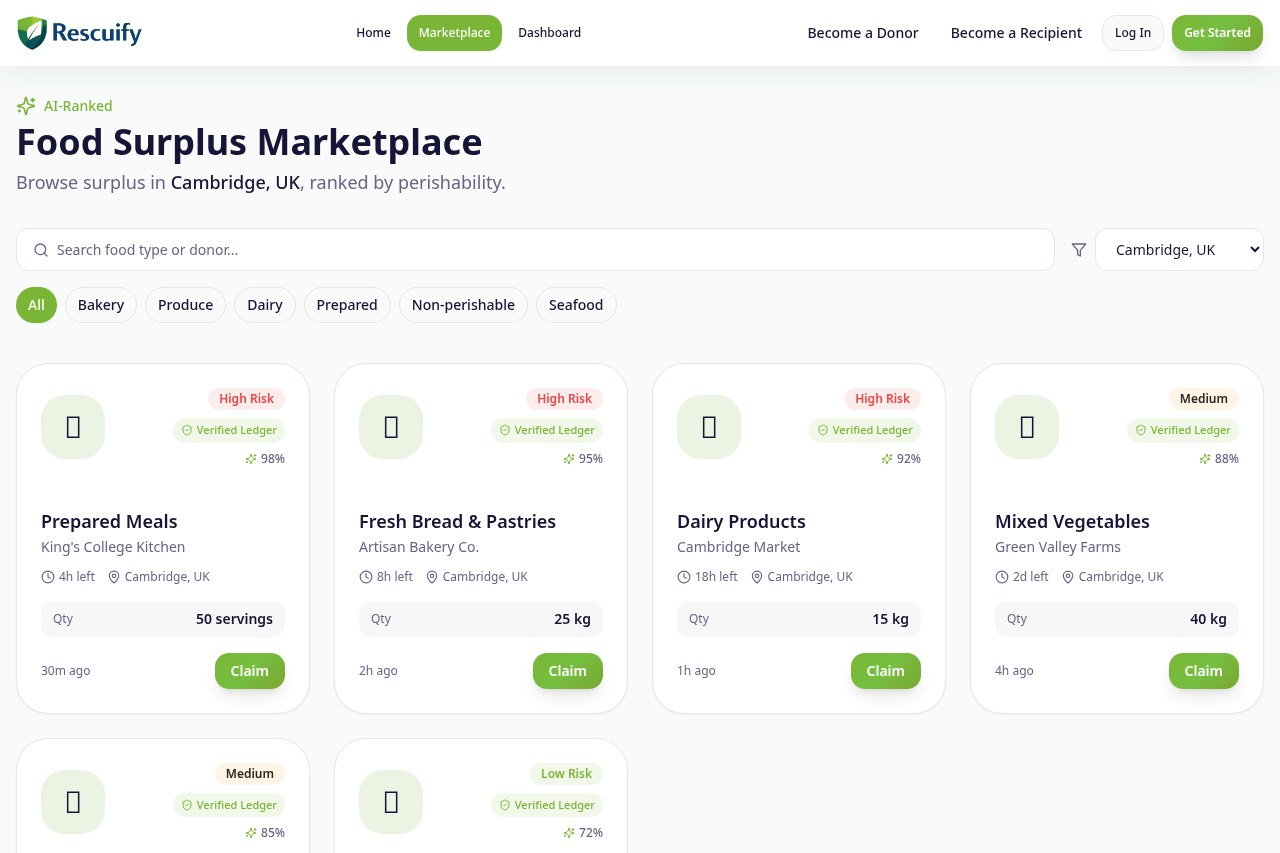
Live product capture
Surplus marketplace ranked by perishability, with verified-ledger badges
Captured from the running prototype.
rescuify.com/marketplace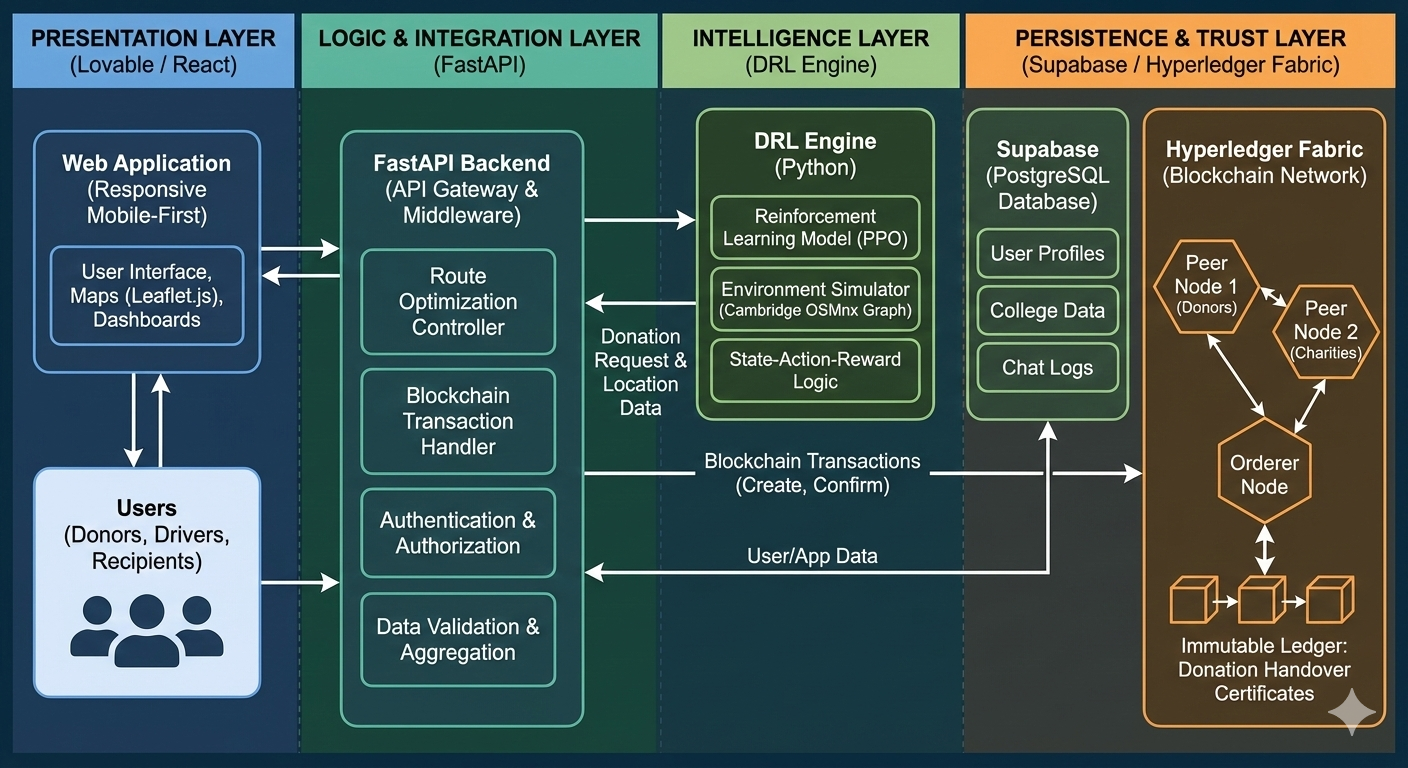
Live product capture
Four-tier cyber-physical architecture
Dissertation architecture figure — presentation, logic, intelligence and persistence/trust layers.
Live product capture
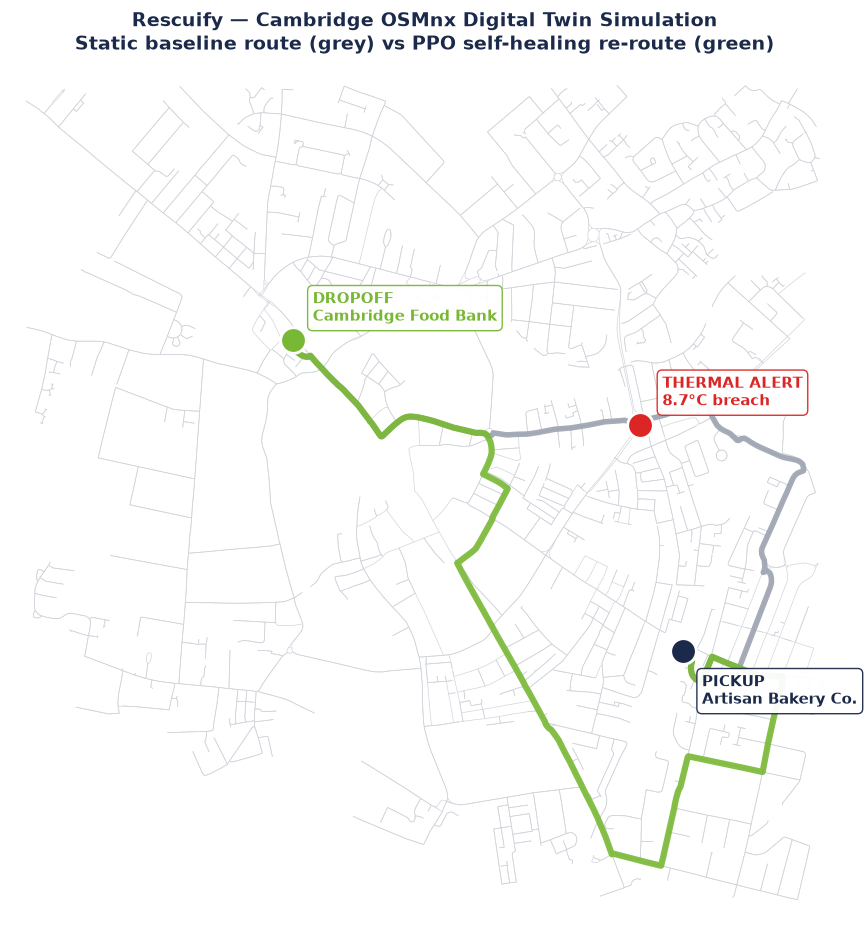
Cambridge OSMnx digital twin — static baseline vs PPO self-healing re-route
Simulation output: PPO re-routes after an 8.7°C thermal breach.
Live product capture
PPO training convergence and static-baseline comparison
Experiment output over 500 simulated Cambridge deliveries.
Live product capture
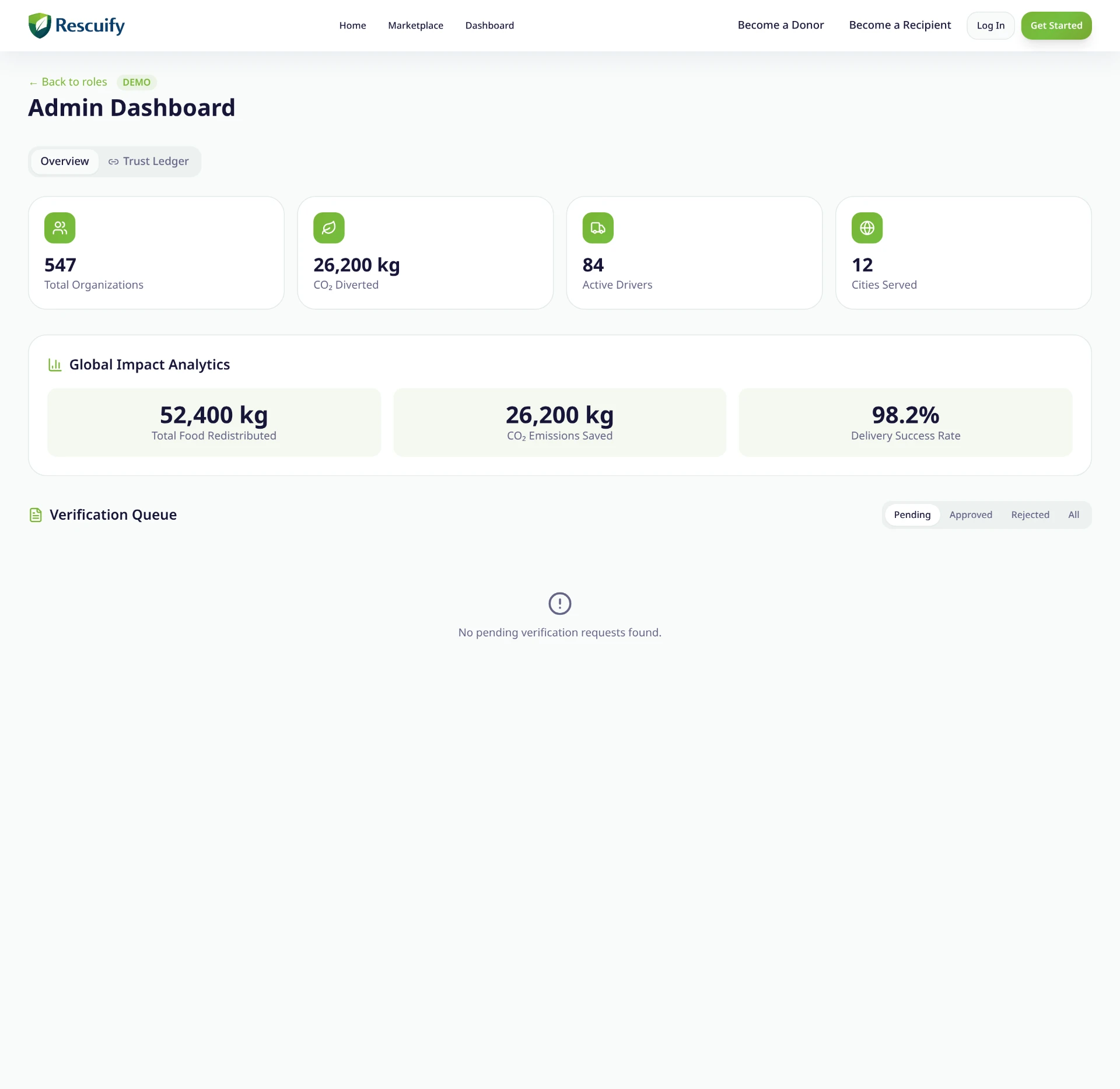
Admin dashboard — platform overview and verification queue
Captured from the running prototype.
Live product capture
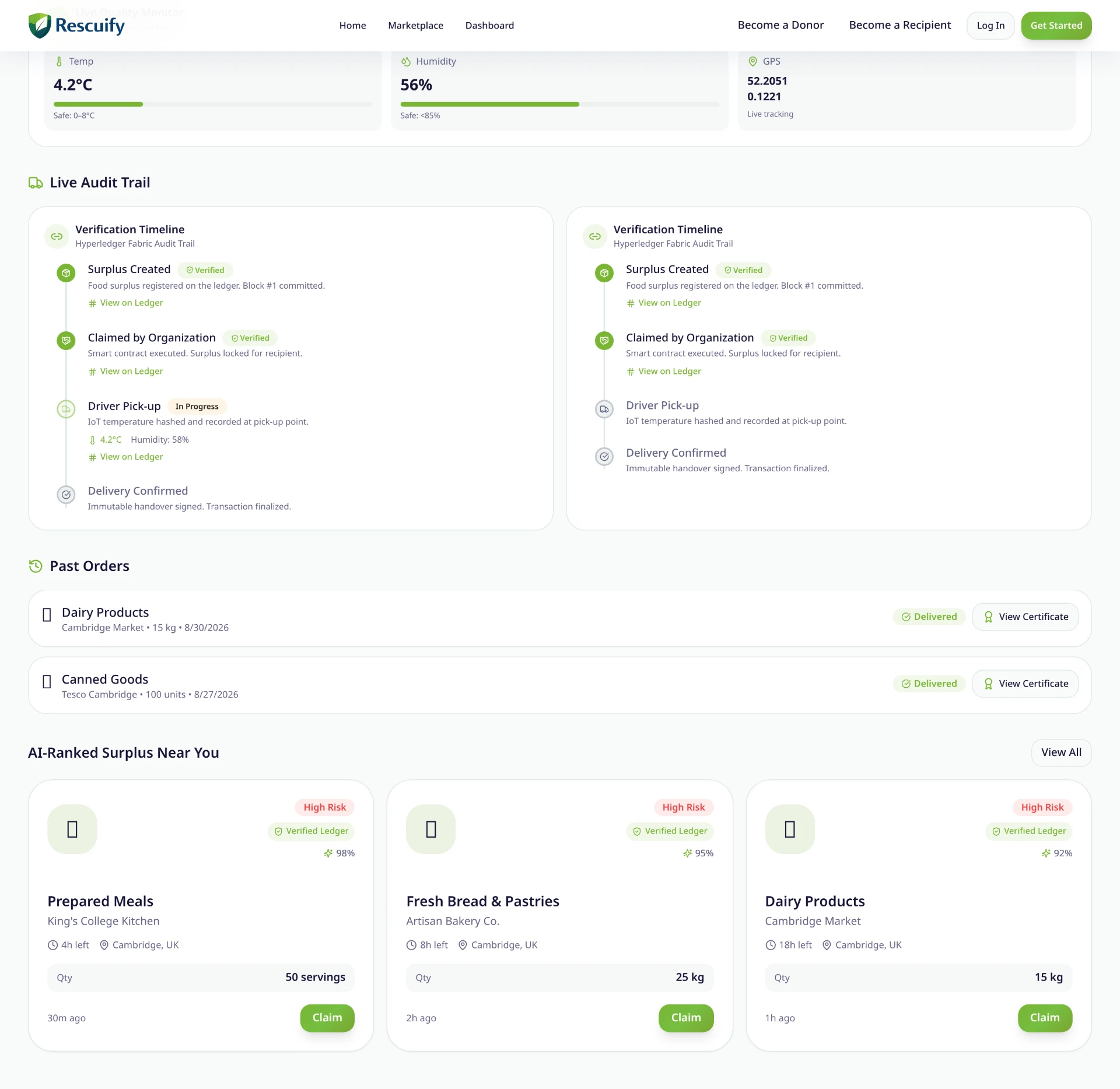
Recipient verification timeline and live cold-chain monitor
Captured from the running prototype.
Live product capture
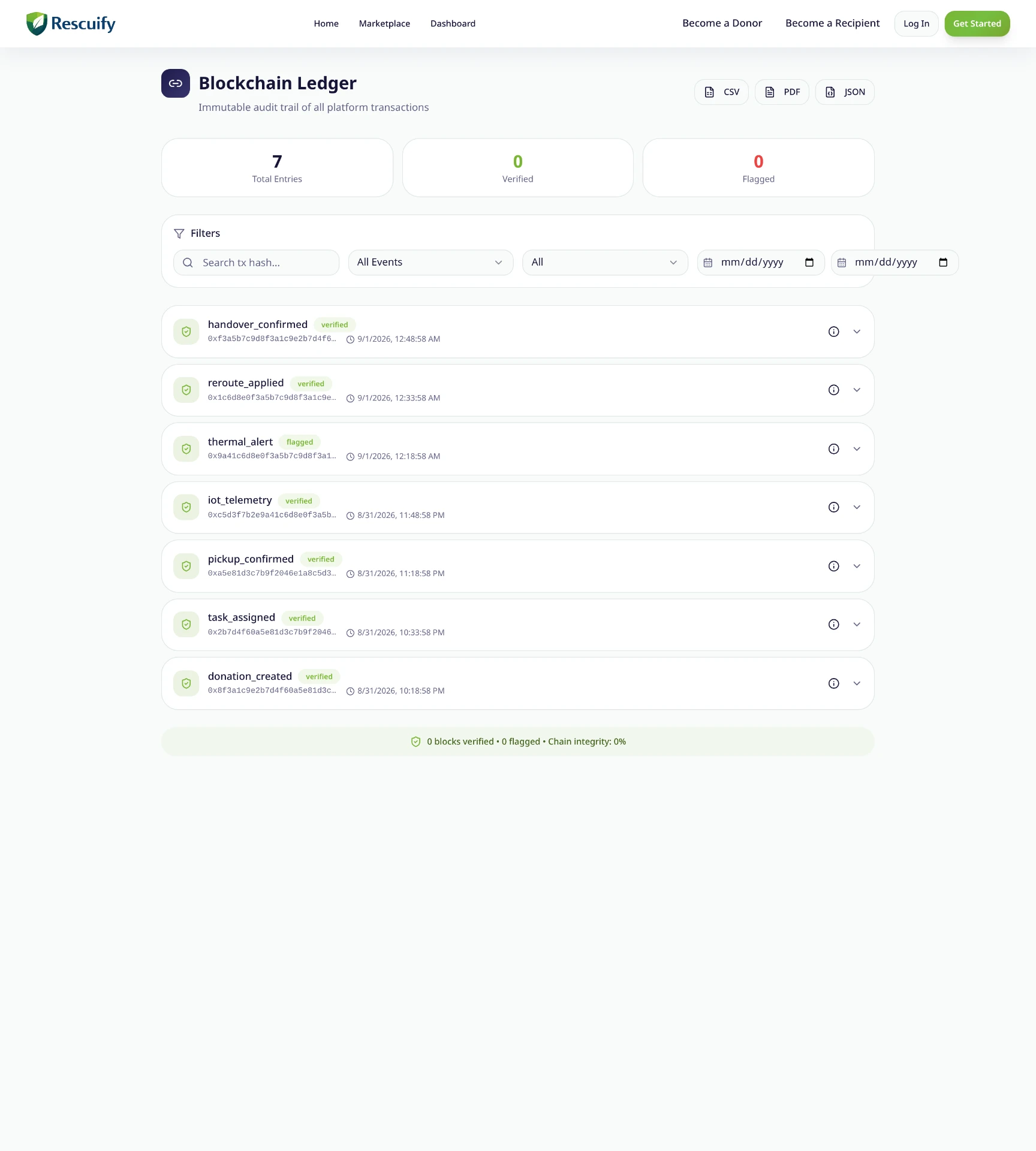
Blockchain ledger page with CSV, PDF and JSON export
Captured from the running prototype.
Measurement & evidence planThe measures being put in place so outcomes can be reported with confidence rather than estimated.10 items
- Dissertation figures: four-tier architecture, data flow and ER diagrams
- FastAPI backend documentation captured during integration testing
- IoT telemetry simulation output logs
- PPO training loop and RL architecture figures
- Donor, driver and administrator dashboard screenshots
- Cambridge digital twin simulation output
- AI-ranked food surplus marketplace screen
- Admin trust ledger and blockchain verification timeline
- Recipient verification timeline
- Full SUS instrument and per-role scores
13
What I learned
A technically impressive feature is not useful unless it resolves a stakeholder risk or a job someone actually has.
Routing optimisation for perishables is a safety problem as much as an efficiency problem, and framing it that way changed what I measured.
Simulation is excellent for controlled experimentation and no substitute for live operational validation — the honest position is to say which one you have.
A trust system is only useful when the user can understand what is being verified and why; a hash nobody reads is not trust.
Integrating AI, sensing and auditability creates more product value than three isolated demos, and considerably more systems complexity.
Product credibility improves when limitations are explicit rather than hidden.
14
Limitations
Stating these plainly is part of the work. These are the boundaries of what the evidence here can and cannot support.
- Reliance on simulated environments rather than live operations.
- Single-agent reinforcement learning, not multi-driver coordination.
- Simplified blockchain implementation using SHA-256 hashing rather than distributed consensus.
- Limited real-world operational data available for training and validation.
- Sim-to-real validation has not yet been carried out.
- No real-world production pilot with a donor or charity.
15
What I would do next
The dissertation's future-work directions translate cleanly into a product roadmap, and every item on it is aimed at closing the gap between simulated and real evidence.
Real-world pilot with a local food bank or charity
The single highest-value next step: move one low-risk redistribution flow from simulation into supervised live use.
Collect operational and user-feedback data
Instrument the pilot so real food saved, distance travelled, delivery success, spoilage events and trust outcomes can be measured rather than modelled.
Multi-agent reinforcement learning
Extend from a single agent to coordinated decisions across multiple drivers and concurrent donations.
Demand forecasting integration
Anticipate recipient need rather than reacting to donations as they appear.
Federated / privacy-preserving learning
Allow organisations to contribute to model improvement without pooling sensitive operational data.
Live IoT data integration
Replace simulated telemetry with physical sensors and validate reliability, calibration and dropout behaviour.
Stronger blockchain and interoperability exploration
Assess whether a real distributed ledger adds value over the hashed audit trail for the stakeholders who would rely on it.
Production security and privacy review
Threat modelling, data-protection assessment and access-control hardening before any live handling of donor data.
Recipient and donor usability studies
Test verification comprehension specifically: can users tell what has been verified, and why it matters?
Regulatory and food-safety validation
Confirm the audit and cold-chain model against the standards redistribution organisations are actually held to.